The Inn at the Crossroads
  • Home
  • About
    • FAQ
    • From Readers
    • About the Author
    • Interviews and Articles
  • Latest Posts
  • Game of Thrones
    • Game of Thrones Recipes, by region
    • Game of Thrones Recipes, by meal
    • The Official Game of Thrones Cookbook
  • Cookbooks!
    • The Official Game of Thrones Cookbook
    • World of Warcraft Cookbook
    • Hearthstone Cookbook
    • Elder Scrolls Cookbook
    • Firefly Cookbook
    • Overwatch Cookbook
    • Star Wars: Galaxy’s Edge Cookbook
    • WoW: New Flavors of Azeroth
    • Star Trek Cookbook
    • Second Game of Thrones Cookbook: Recipes from King’s Landing to the Dothraki Sea
      • Game of Thrones Cookbooks Bibliography
    • Errata
  • Other Recipes
    • Other Fictional Foods
    • Other Historical Foods
    • Everything Else!
  • Contact
    • Sign Up for News!

Category Archives: Historical

Eggs for Breakfast – 1890s

Thoughts:

Creamy, delicious eggs. Savory from the broth and mushrooms, with the slightest crunch lent by the onions. It’s not quite an omelet, nor yet scrambled eggs, but something like both, in that the chopped whites and yolks of hard-boiled eggs are combined in a thick, creamy sauce. It’s an interesting spin on eggs for breakfast, and a great way to use up any leftover hard boiled eggs you may have in the fridge. In fact, I bet it would be a terrific way to use up leftover deviled eggs from a party (if there is such a thing… I usually eat them all!). The mustard would be a welcome addition, I think.

I recommend expanding on the original recipe, and putting a hefty layer of the egg mixture on a slice of toast, topping with a sharp cheese, and setting it under the broiler for just long enough to melt the cheese. With this treatment, it can actually stand as a breakfast main course, rather than a side.


Recipe for Eggs for Breakfast

Boiling eggs: 10 minutes       Prep time: 15 minutes

Serves 3-4

Cook’s Note: I haven’t the faintest idea where the bay leaf is meant to figure in, so I’ve omitted it altogether. If you like, I suppose you could let it sit awhile in the stock to pass on a bit of the flavor.

Ingredients:

  • 6 mushrooms, diced (~1/4 cup)
  • 6 hard boiled eggs, divided into whites and yolks, both chopped small
  • 1 slice of onion, diced (~1 1/2 Tbs.)
  • 2 Tbs. butter, divided
  • 1 Tbs. flour
  • 2 Tbs. cream
  • 1 cup stock
  • salt & pepper to taste

Saute the mushrooms in 1 Tbs. butter until soft. Remove from pan and set aside. 

Melt the rest of the butter, and add the flour. Stir until the butter bubbles and turns golden. Pour in the stock and cream and stir until it  reaches a smooth consistency. Add the chopped egg whites, mushrooms, and salt & pepper to taste. Bring to a bubble, then crumble the yolks into the mixture. Turn off heat and stir to combine. 

Apple Custard Pie

Thoughts:

I love this recipe. It’s versatile enough to be made into a pie, or into smaller tarts, or even into a crustless custard, in ramekins. I was a smidge distracted the first time I made this, so was surprised that the filling is really enough for two pies. 

The filling thickens to a nice smooth consistency, appley in flavor along with the more familiar elements of custard. It’s mildly sweet, not overpoweringly so, which lets all the natural flavor of the apple and the bite of the nutmeg shine. All in all, it’s a simple dish that’s easy to prepare, and easy to appreciate. Plus, it’s a great use for some of those autumn apples you might have lying around!


Apple Custard Pie Recipe

 Prep: 10 minutes       Baking: 45 minutes to an hour

Makes: 2 pies      

Cook’s Note: I use applesauce in the recipe below to simplify things, but if you have proper orchard apples, stewing them down for this custard is a wonderful use for them. Also, although not listed in the original, I added a splash of brandy  and a dash of vanilla. Feel free to play, and make the recipe your own!

Crust Ingredients:

  • 3 cups flour
  • 1/2 stick butter (4 Tbs.)
  • 1/4 cup shortening
  • 1/4 cup sugar
  • pinch of salt
  • ice water, just enough

Custard Ingredients:

  • 3 cups applesauce
  • 1 cup white sugar
  • 6 eggs, divided
  • 1 quart milk (4 cups)
  • 1 tsp. vanilla extract
  • 1 Tbs. brandy
  • nutmeg to taste

Make the crust by cutting the butter and shortening into the flour, then add the sugar and salt. Pour in just enough water to bring the dough together, and try not to overwork it. Roll out to about 1/4″ thickness, then line two pie pans with it. Crimp the edges decoratively, and prick the bottoms of the pies all over with a fork (this keeps the dough from bubbling up). 

Pour the applesauce into a fine sieve, and allow any extra water and juices to drain out; this will help the custard filling set up nicely. Place the drained applesauce in a large bowl, and add the sugar, yolks, and nutmeg. Beat thoroughly, and add the milk, followed by the whites, beating all the while. 

Pour the custard into the prepared pie pans; any extra can be poured into ramekins or other oven-safe dishes. Bake for around 45 minutes, or until the center of the pies are set. Remove from the oven, let cool, sprinkle with a little decorative nutmeg, and enjoy!

To make poor Knights

I was first intrigued by the title of this recipe, then delighted when I recognized it for what it is:

Medieval French Toast.

In the UK, strips of toast are called “soldiers”, and I can only assume that there is some etymological connection between the two. 

In Sweden, this dish is still known by the medieval name, or “fattiga riddare”, with similar meanings in other Scandinavian countries, and in Germany as “arme ritter”. The German version may be dated back to Ein Buch von Guter Spise in the 14th century. The Germans also have a version made with wine instead of milk that roughly translates to “drunken virgin”. Clearly, our German housemate has been keeping things from us.

The ancient Romans were the first to make this dish, although Apicius just called it, “another sweet dish”. Modern Italians have a savory version that involves slices of mozarella sandwiched between bread, the whole of which is then dipped and fried. Must. Try.

In some countries, it is a savory dish. In others, it is served for dessert. Whatever the case, this fantastic food is one of my favorites, and one I will have to keep exploring. 

 At this rate, I might have to do a whole french toast book…

If you have a favorite regional or international recipe for French Toast, I’d love to read it!

Thoughts:

I actually really loved this breakfast. I’m normally a die-hard maple syrup fan, to the point that I won’t order French Toast unless I know I can get real syrup with it. But somehow, with the rustic, seedy bread and primitive plate, I genuinely preferred the rose syrup.

As a general rule, I tend to dislike anything floral flavored. I prefer the nutty varieties of Turkish Delight to the Rose version, and really don’t care for flowery anything in my own kitchen. However, the vibrant punch of this rosewater syrup actually better compliments the french toast than does the maple syrup. I tried it both ways, just to be sure. ;)

The recipe will vary with the type of bread you use. I opted for a loaf of multi-grain seedy bread, which lent the toasts some interesting texture and depth. Try it out this weekend, and see for yourselves whether you prefer the rose or maple syrups!


French Toast from 1655

Cut two penny loaves in round slices, dip them in half a pint of Cream, or fair water, then lay them abroad in a dish, and beat three Eggs and grated Nutmegs and sugar, beat them with the Cream, then melt some Butter in a Frying-pan, and wet the sides of the Toasts and lay them in on the wet side, then pour in the rest upon them, and so fry them, serve them in with Rose water, sugar and butter. -The Complete Cook, 1655

Prep: 5 minutes          Cooking: 15 minutes          Syrup: 10 minutes

Serves: 8

Cook’s Note: Unless you are feeding a small army, you probably won’t need to make the full batch. I cut mine in half, and used 2 eggs. 

Ingredients:

  • 2 loaves bread (about 1 lb. each), the more rustic the better
  • 2 cups cream
  • 3 eggs
  • 1 tsp. nutmeg
  • 1/4 cup sugar
  • butter enough for frying (several Tbs.)

Rosewater syrup

  • 2 Tbs. butter
  • 1/2 cup sugar
  • 1/2 cup rosewater

Make the Rosewater Syrup first: Melt the butter in a saucepan, then add the sugar and rosewater. Bring to a boil, then turn down slightly and allow to simmer for about 5 minutes, or until the mixture is bubbling wildly and has thickened. Pour into a serving vessel and keep warm. 

For the French Toast, whisk together all the ingredients. Melt a little butter in a frying pan. Dip the sliced bread into the mixture, wetting both sides, then place in the pan. Cook until each slice of toast is golden brown on each side. Place on a plate and cover to keep warm while you finish cooking the rest of the toasts. 

 Serve everything warm, with extra butter if desired, and the syrup over top. You may also indulge in a bit of powdered sugar. 

*Fun Fact: A “Penny Loaf” was a loaf of bread of a standardized size. The Assize of Bread in the 13th century mandated that all bread in the UK be standardized. In 1757, a penny loaf could weigh between six to nine and a half ounces, depending on the quality of the wheat. I’d wager that a penny bought more bread 100 years before, and would hazard a wild guess that it would be about a 1 lb. loaf. 

Seed Cake with Emptins – 1798

Thoughts:

This recipe results in a somewhat quirky loaf that falls somewhere between a heavy cake and a very serious shortbread. One slice will go a long way, and is best spread with a bit of salted butter. 

Ingredients:Full Batch                                       Half Batch                             Quarter Batch

  • 1 lb. sugar                                       1/2 lb. sugar (1 cup)        1/2 cup sugar
  • half ounce allspice                      1/4 ounce allspice            1/2 Tbs. allspice
  • 4 quarts flour (16 cups)            8 cups flour                          4 cups flour
  • 1 lb. butter                                     1/2 lb. butter                      1 stick butter, melted into
  • 1 pint milk                                      1 cup milk                             1/2 cup milk
  • 9 eggs                                               4 eggs                                     2 eggs
  • 1 gill emptins                                2 oz. emptins                      1 oz. emptins
  • seed                                                  seeds                                      2 Tbs. seeds
  • currants                                          currants                                1/2 cup currants or chopped raisins

These instructions are for the quarter batch,  Bake at 350 F for 1-1 1/2 hours, or until it’s slightly brown on top. 

Mustard recipe from Oldtown

Roman Mustard

“‘There’s cold beef in the kitchens. And mustard in a big stone jar, from Oldtown.’ The thought of that mustard made the old woman smile.” -Feast for Crows

Modern Mustard

Our Thoughts:

I have a confession to make.

I don’t actually like mustard.

I’ve tried to cultivate an appreciation for it over the years, but without any great success. Thankfully, the Inn is filled with mustard fiends, all of whom were more than happy to be tastetesters for this particular post.

Because it is hand ground, the Roman mustard is very coarse, with a bit of a crunch lent it by the larger pieces of mustard seed. The ground nuts combined with the vinegar and honey to make a sort of binder for the seeds, tying the whole condiment together. The resulting spread has a notable bite to it, and is deliciously rustic. Even I could learn to love it.

The modern mustard also has a bite, but like any good mustard, the bite is not cumulative. Not as coarse as many imported French mustards, it has just enough graininess to give it a pleasant old world feel. Rich and profoundly mustardy, it i  Is particularly delicious with a sharp cheddar, and would pair brilliantly with ham. It tastes like an expensive blend from a rural farmer’s market, one that you would have no regrets about purchasing.


Roman Mustard Recipe

[204] MUSTARD BEANSALITER: FABACIÆ EX SINAPI[The beans previously cooked are seasoned with] CRUSHED MUSTARD SEED, HONEY, NUTS, RUE, CUMIN, AND SERVED WITH VINEGAR. – Apicius

Ingredients:

  • 1 cup black or brown mustard seeds
  • 1/2 cup almonds, chopped fine
  • 1/2 cup pine nuts, chopped fine
  • 2-3 teaspoons salt
  • a pinch of cumin
  • honey to taste (I used about 2 Tbs.)
  • 1 cup cold water
  • 1/2 cup red wine vinegar

Grind the whole mustard seeds for a few seconds in a spice or coffee grinder, or by hand with a mortar and pestle. You want them mostly whole. Add the chopped nuts and grind into a paste. Move everything to a bowl and add the salt, cumin, honey, and cold water. Mix well and let stand for 10 minutes. Pour in the vinegar and stir well. When the vinegar is incorporated, pour into a glass jar and store in the fridge. Wait at least 24 hours before using. Mustard made this way will last several months in the fridge.

Modern Mustard Recipe

  • 1/2 cup yellow mustard seeds
  • 3 Tablespoons dry mustard
  • 1 cup water
  • 3/4 cup tarragon vinegar (or any other herb vinegar)
  • 1 Tablespoon honey
  • 2 teaspoons salt
  • 2 Tablespoons chopped fresh thyme (or any mixture of fresh herbs that you enjoy)

Put the seeds, dry mustard, and water in a bowl.  Let this mixture stand 2 hours or until the seeds become soft.  Stir mixture every 15 minutes or so. When the seeds are soft, put the mixture in the food processor and run until the mixture is smooth.  This took about 5 minutes.  I wanted some texture to remain in my mustard so I left some seed pieces. Add the vinegar, honey, salt and herbs.  Place in a lidded jar and allow to stand at room temperature to mellow.  This mixture will be very hot.  Once the mustard is to your taste (mine took about 1.5 hours) keep it in the fridge.  It will keep in the fridge for several months, but could be stored if you choose to use the proper canning technique.


Butter Biscuits – 1798

Thoughts:

True to their name, these are quite buttery. More what we might think of as modern rolls rather than biscuits, they are simple and wholesome, stopping just shy of fluffy. Because they are so simple, they are a perfect vehicle for your choice of condiments, including jam, clotted cream, or honey on the comb.

Colonial Butter Biscuits Recipe

Quarter Recipe Yield: 10 small biscuits

Sponge: overnight       Prep: 10 minutes       Baking: 25-30 minutes


Ingredients:

              Full Batch                   Half Batch                Quarter Batch

  • 1 pint milk                  1 cup milk                  1/2 cup milk
  • 1 pint emptins          1 cup emptins           1/2 cup emptins (or sourdough starter)
  • flour                              flour                             1/2 cup flour
  • 1 lb. butter                 2 sticks butter          1 stick butter
  • another pint milk    1 cup milk                  1/2 cup milk
  • more flour                  flour                             2 cups flour, plus a bit more

Mix the half cup milk with the half cup emptins, along with a 1/2 cup flour to make a sponge. Cover loosely with a dish towel and let sit out overnight. In the morning, your sponge will be larger, bubbly, and, well… spongy. 

Melt 1 stick of butter into another half cup of milk, and let cool until it’s just warm; if too hot, it will kill the yeast in the sponge. Add to the sponge, and gradually mix in 2 cups flour. At this point, you should have a thick batter. Gently knead in additional flour until the whole mixture comes together into one cohesive mass that is soft but not sticky.

Tear off 8 pieces of equal size, and gently form into small rounds. You may either place these directly onto a baking sheet, or into the cups of a muffin pan.

Bake at 350 F for 25-30 minutes, until the tops are just slightly golden, and the biscuits feel firm to the touch.

They are best served with jam, honey, or clotted cream.

Honeycakes

Elizabethan Honeycakes
“She still remembered the innkeep, a fat woman named Masha Heddle who chewed sourleaf night and day and seemed to have an endless supply of smiles and sweet cakes for the children. The sweet cakes had been soaked with honey, rich and heavy on the tongue…” -A Game of Thrones

Modern Honey-ginger cakes

Our Thoughts:

We had initially intended to make two versions of this dessert, but after some trouble tracking down a suitable old one, and after tasting the modern version, we couldn’t wait to share.

While the Elizabethan version is very light, fluffy, and ohsotasty, it is more of a bun than a cake. As such, it didn’t respond well to my initial attempts to soak it in honey. It would accept a honey glaze once it had cooled down, but still lacked that really over the top sweet honey kick. So I went a step further, and filled them with honey. YES.

The modern cakes are also wonderful. They make these dense, doughy little cakes bursting with honey flavor and the subtlest of spices. We finished ours with lavender icing, and can’t imagine a better pairing. We thought they couldn’t get any better until we tried soaking a few in about 1/4″ of honey overnight. Result? Sheer decadence. The honey hits the tongue, the lavender hits the palate, and the whole thing is amazing. Our batch lasted about 5 whole minutes…

If anyone has a solid recipe for an older honeycake, we’d love to see it. In the meantime, we’ll be in the kitchen, eating these cakes until we run out, or can’t fit through the door.

Elizabethan Honeycake Recipe

Elizabethan Almond Cakes- Take one peck of flower, one pound of sugar, one pound of almons, beaten & strained with as much ale as will stiffen your paste, put theirto three spoonfulls of barme, & a few annisseds, then woork it well together, then make it in little cakes, prick them thick for rising & bake them. Elinor Fettiplace’s Receipt Book, 1604

Makes about 12 buns

Prep: 10 minutes           Rising: 1.5 hour, minimum            Baking: 15 minutes

Our changes: No aniseseeds, don’t like ’em. You are more than welcome to include them if you do, however.  We basically used the original recipe, but added honey to the batter, as well as soaking the cakes in honey for a while.

Ingredients:

  • up to 3 1/2 cups flour
  • 3 Tbs. honey
  • 2 tsp. sugar
  • 3 Tbs. ground almonds
  • 1 packet yeast, or 2 1/4 tsp.
  • 1/2 pint ale (1 bottle)
  • pinch of salt
  • honey for soaking, probably around 1/2 cup at least
Dissolve the yeast in the warmed ale, and leave to froth up.  Grind the almonds and sugar in a food processor, then combine with the flour and salt in a large bowl. Make a small well in the mixture, and pour in the yeasty ale. Adding the flour a bit at a time, work everything all together until it is a nice smooth, pliable consistency  leave in a warm place until it has doubled in size. After it has risen, knock it down and knead it for a few minutes before shaping it into around 10 small buns.
Allow the buns to rise again for at least 15 minutes, then bake in a preheated oven for 10-20 minutes at 375 degrees F. The buns should be just slightly golden.
Using a small paring knife, cut a small hole (about 1/2″) in the tops of the buns, poking well down into the cake, but taking care to not poke all the way through. Take a small spoon and carefully fill each hole with honey. You may need to do this several times as the honey soaks into the cake. Put in at least 1 Tbs. honey per cake.

Modern Honeycake Recipe

Makes: never enough

Prep: 15 minutes           Bake: ~30 minutes

Ingredients:

  • 2 1/2 cups cake flour
  • 1/2 tsp. baking powder
  • 1 tsp. salt
  • 1 tsp. ground ginger
  • 1 tsp. cinnamon
  • 1/2 cup butter
  • 1/2 cup brown sugar, packed
  • 1 egg
  • 1 cup honey
  • 1 cup buttermilk

Sift together the dry ingredients. In a separate bowl, cream together the butter and sugar. Add egg and beat thoroughly, followed by the honey. Add the flour mixture and the buttermilk in alternating turns, starting and ending with the dry ingredients. Pour into paper lined cupcake tins, or a greased muffin pan, filling each cup 2/3 full. Bake at 350F for 30 minutes or until the cakes are a golden brown.

Martha Stewart’s lavender icing recipe: http://www.marthastewart.com/340910/lavender-icing


Cod Cakes

Roman Cod Cakes

“The wedding guests gorged on cod cakes and winter squash, hills of neeps and great round wheels of cheese, on smoking slabs of mutton and beef ribs charred almost black…” -A Dance with Dragons

Modern Cod Cakes

Our Thoughts:

The Roman cod cakes are quirkier than what we’re used to when we think of fish cakes, but they’re also quite good. The cod is a nice, mild white fish, which lets the other flavors and textures have a turn in the spotlight. The cilantro is not overpowering, and the wine imparts a subtle sweet flavor. The leeks give an overall crunchiness, while the occasional caper provides a pop of vinegar. We weren’t great fans of the sauce, however; It’s a little too peculiar a pairing for our taste!

The modern cakes were excellent. Just a little crispy on the outside, but with a moist cod-potato filling on the inside. A little salt and a dash of lemon complete the meal, and they’re equally good right out of the frying pan as they are straight from the fridge.

Winner? I’m really not sure. The modern cakes win for general likeability, but the Roman cakes are unique and special. My personal ideal might be a combination of the two, with turnips swapped in for the spuds, and the sauteed leeks added in.


Historical Cod Cakes Recipe

Minutal marinum: pisces in caccabum, adicies liquamen, oleum, uinum, cocturam. porros capitatos, coriandrum minutatim concides, isiciola de pisce minuta facies et pulpas piscis cocti concerpis, urticas marinas bene lotas mittes. haec omnia cum cocta fuerint, teres piper, ligusticum, origanum, fricabis. liquamen suffundes, ius de suo sibi, exinanies in caccabum. cum ferbuerit, tractam confringes. obligas. cum ferbuerit, agitas. piper aspargis et inferes. [Place the fish in a saucepan, add broth, oil, and wine. Also finely chop leek heads and coriander. Form it into small cakes, adding capers and well-cleaned sea nettles. These fish cakes cook in a liquor of pepper, lovage, and crushed oregano, diluted with broth and the above fish liquor. Skim well, bind, stir over the cakes, sprinkle with pepper and serve.] – Apicius, 4th Century

Cook’s Notes: Sea Nettle is a jellyfish. Although there were a few washed up on the beach when I went to photograph the dish, I left out it out for simplicity’s sake. I also opted for the more traditional route of frying the cakes, as they fell apart completely when I tried to cook them strictly according to the recipe.

Ingredients:

  • 1/2 lb. cod, cut into large chunks.
  • 1/2 cup broth
  • 1 Tbs. olive oil
  • 1/2 cup wine (I used a semi-sweet red)
  • 1 leek, diced
  • 1-2 Tbs. fresh cilantro, diced
  • 2 Tbs. capers
  • 2 eggs
  • 1/2 – 1 cup breadcrumbs
  • olive oil for frying

For sauce:

  • pinch of pepper
  • 1 tsp. lovage root
  • 1 tsp. oregano
  • remaining broth, from above
  • roux (1 Tbs. oil, 1 Tbs. flour)

Poach the cod in the broth until it is flaky, around 5 minutes.  Fish out the cod, place in a bowl, and crumble. Add the leek, cilantro, and capers, then the eggs and 1/2 cup breadcrumbs. Mix this thoroughly by hand, and try to make a few patties with them. Add more breadcrumbs as needed.

Once you have a consistency that will work, form the mixture into cakes and fry in oil over medium heat. The cakes should be golden brown, and just a tad crispy. Place on a plate covered with paper towel to drain.

To the poaching broth, add lovage, oregano, and pepper. Simmer until this sauce has reduced slightly, about 5 minutes. Strain, then thicken with a roux.

Serve cod cakes while still warm, with sauce on the side, or drizzled over.

Modern Cod Cakes Recipe

Cook’s note: This recipe is “modern” because of the inclusion of potatoes, a decidedly non-Westerosi ingredient.

Ingredients:

  • 1 lb of cod fillets
  • 2 medium-sized russett potatoes
  • 1 cup bread crumbs
  • 1/4 cup chopped fresh parsley
  • 2 Tbsp freshly grated Parmesan cheese
  • 2 garlic cloves, finely chopped
  • 1 teaspoon salt
  • 1/2 teaspoon pepper
  • 2 eggs, lightly beaten
  • Grapeseed oil, or other high smoke point oil such as canola oil, for frying

Boil and mash the potatoes, set them aside. Boil the codfish until it flakes easily. Drain and flake the fish with a fork. Be sure to remove all bones. Mix the flaked fish, the potatoes and the rest of the ingredients together well by hand. If the mixture is too crumbly, add another egg. If too sticky, add some more bread crumbs. Form the mixture into cakes and fry them on medium high heat in a skillet coated with oil, until nice browned on one side, then flip them over and continue to cook until well browned on the other side. Yield: Makes 12 fish cakes. Serves 4-6.

Hotel McAlpin Cream Puffs

This recipe requires a small amount of back story, but will be well worth it, I promise you!

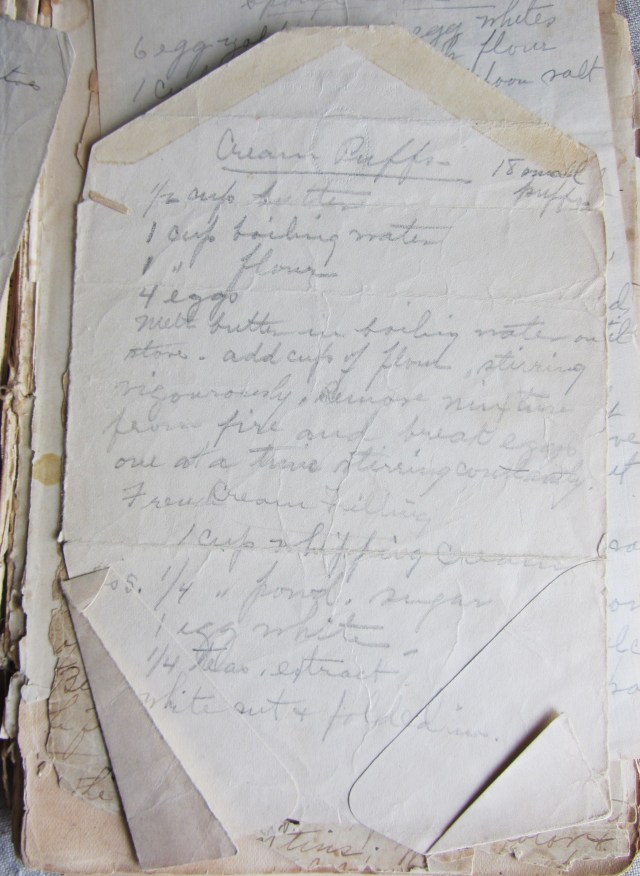
In the old family cookbook –For the full story on the book, go here— amidst other random bits of papers and miscellany, I found this envelope, marked with a crest. Naturally curious, I followed the paper trail, and discovered not only what might be the only surviving copy of the hotel’s Cream Puffs, but also fascinating details about the hotel and dessert. 

The Hotel McAlpin was built in 1912 on the corner of 34th and Broadway in Manhattan. At the time it opened, it was the largest hotel in the world, had a veritable fleet of staff that numbered more than half the total guests, and even boasted a Turkish Bath on the top floor. 

Hotel McAlpin,1914

In the 1950s the hotel was lumped into the Sheraton hotel conglomerate, and in the 70s was converted to rentals. Today, sadly, it is full of condos, but in its prime was one of the striking hotels in NYC, housing guests during both World Wars and the 1939 World’s Fair. 

The hotel was also famous for its Marine Grill, whose walls and ceiling were lined with custom tile mosaics depicting scenes from New York Harbor, designed by Fred Dana Marsh. Just barely saved when the hotel was renovated in the 80s, the tiles are now reconstructed in the Fulton/Broadway/Nassau subway stop. The original tiles are visible in this postcard:

Of especial interest here, though, is what was served in said restaurant, including the hotel’s recipe for Cream Puffs. Written on a sliced-open envelope of hotel stationary, the recipe is loosely scrawled in pencil. Presumably, one of my more enterprising ancestors wheedled the recipe out of the hotel chef.

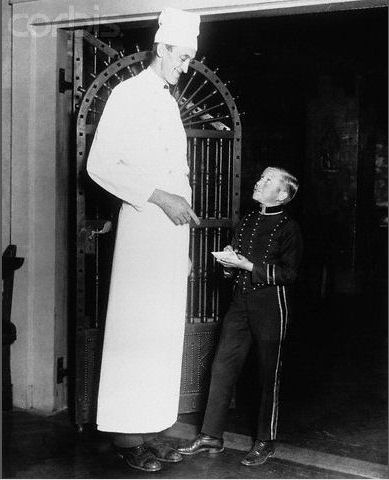
As if it couldn’t get any cooler, I am keenly hoping that this cream puff recipe can be traced back to the period between the 1920s and the 1950s, when Champion Cream Puff Maker Forrest Glen worked there. As you can see from this photo, at over 7′ tall, Chef Glen was also rather tall.

Forrest Glen, Hotel McAlpin’s Champion Cream Puff Maker
photo taken 1925

Based on this reconstructed recipe, the man was indeed a Champion. A giant, if you will, among dessert designers, and a connoisseur of cream filling.  Behold, his delicious Cream Puffs:

 Thoughts:

Perhaps the best part about this recipe is that it is so easy to make; in well under an hour, you can have a platter filled with these decadent Creme Puffs. The pâte à choux is straightforward process from beginning to end, resulting in tender, hollow little globes of pastry that are the ideal vessel for the filling.

Very light, but sublimely rich, the filling is the star of this dessert. The smell of vanilla curls up from the mixing bowl, enticing one to dip a finger and taste. The secret knowledge of the decadent creme lying in wait within the pastry is a promise more than fulfilled with the first bite. The pastry gives way with little resistance as the filling shifts, always seeming to overflow its bounds in the least expected direction. 

A shockingly simple recipe, with stellar results, this one has made it to my permanent cookbook.

Hotel McAlpin Cream Puff Recipe

Makes about 18 Cream Puffs

Prep: 15 minutes           Baking: 20 minutes           Filling: 10 minutes

Ingredients:

  • 1/2 cup butter
  • 1 cup boiling water
  • 1 cup flour
  • 4 eggs

Line a baking sheet with parchment paper, and preheat oven to 400F.

Melt butter in boiling water on stove. Add cup of flour, stirring vigorously until the mixture has become a sort of thick paste. Transfer the dough to the bowl of a stand mixer (or a regular kitchen bowl, for use with hand mixer). Break the eggs one at a time into the dough while mixing, making sure each egg is fully incorporated before adding the next. The final batter should be smooth.

Transfer the batter into a pastry bag or a ziploc with one corner cut off. Pipe the batter onto the parchment paper, making large blobs about the size of golf balls, set at least 1 1/2″ apart. You should get about 18 puffs total.

Bake the puffs for about 20 minutes, or until they are a rich golden color. 

French Cream Filling:

  • 1 cup whipping cream
  • 4 Tbs. milk 
  • 1/4 cup powdered sugar
  • 1 egg white
  • 1/4 tsp. vanilla extract

Mix heavy cream with the milk and beat until stiff. In a separate bowl, beat the egg white until it too is stiff. Add the sugar and vanilla to the beaten egg white, beat for a few more seconds to mix. Fold the stiff egg mixture into the whipped cream. Immediately transfer to a piping bag, or set to chill in the fridge.

When the pastry puffs have cooled, the cream can be piped into them. Give each puff a good squeeze of the filling, but make sure you have enough to go around. You may also split the puffs and simply spoon the filling in, but I found that this made for messier eating, with more places for the filling to go. If you like, drizzle with a little chocolate. 

The finished Cream Puffs should be enjoyed shortly after making them, but can be chilled for a few hours. 

This slideshow requires JavaScript.

Welsh Rabbit – The Hobbit

Thoughts:

Although the dish can be sourced back to the early 1700s, the origin of the name is unclear. In any case, this is the ultimate Bag End variety of grilled cheese, this recipe is equally well suited to the savory spread of First Breakfast, or the mouthwatering array of Dinner.

The basic concept is that one combines cheddar, beer, and mustard, fluffs it up with some egg, then broils the whole thing on slices of toast. The resulting snack provides a wonderful array of textures, from the crunch of the toast to the rich, fluffy give of the topping. The taste is reminiscent of beer mustard on a pretzel, although the choice of a darker rye bread gives the whole dish a wonderful, rich earthiness that perfectly suits those agricultural savvy hobbits.

Welsh Rabbit Recipe

Ingredients:

  • 2 Tbs. butter
  • 1 shallot, sliced thin
  • 1 cup grated cheddar
  • 1/3 cup ale or lager
  • 1 tsp. mustard
  • pinch of salt
  • 2 eggs, lightly beaten
  • 4 slices of bread, your choice
  • black pepper

Melt the butter in a saucepan, then add the shallot until it has softened. Add the cheddar, ale, mustard, and salt. Stir over low heat until the cheese has just melted. Add the eggs and stir until the mixture has slightly thickened, around 2 minutes. Be sure to not overcook, or you’ll end up with scrambled eggs!

Toast the bread, then spoon the cheesy mixture over the top of the toast. Cook under a hot broiler until the top is puffy and golden. Sprinkle generously with black pepper, and serve. 


« Previous Page
Next Page »

Made something?`

If you’ve made a recipe from the blog, be sure to tag your tasty creations with #GameofFood!

Support the Blog!

If you love the content here, please consider becoming part of our Patreon community!

Support the blog by becoming a patron!

Affiliate Disclaimer

Please bear in mind that some of the links on this website are affiliate links, meaning that if you go through them to make a purchase I may earn a small commission. I only include links to my own books, and products I know and use.

CyberChimps WordPress Themes

All content copyright 2024