The Inn at the Crossroads
  • Home
  • About
    • FAQ
    • From Readers
    • About the Author
    • Interviews and Articles
  • Latest Posts
  • Game of Thrones
    • Game of Thrones Recipes, by region
    • Game of Thrones Recipes, by meal
    • The Official Game of Thrones Cookbook
  • Cookbooks!
    • The Official Game of Thrones Cookbook
    • World of Warcraft Cookbook
    • Hearthstone Cookbook
    • Elder Scrolls Cookbook
    • Firefly Cookbook
    • Overwatch Cookbook
    • Star Wars: Galaxy’s Edge Cookbook
    • WoW: New Flavors of Azeroth
    • Star Trek Cookbook
    • Second Game of Thrones Cookbook: Recipes from King’s Landing to the Dothraki Sea
      • Game of Thrones Cookbooks Bibliography
    • Errata
  • Other Recipes
    • Other Fictional Foods
    • Other Historical Foods
    • Everything Else!
  • Contact
    • Sign Up for News!

Category Archives: Uncategorized

Spicy Lamb Wraps – A Flight of Marewings

Spicy Wraps with grilled veggies, from A Flight of Marewings
“Korinna looked down suspiciously, but she recognized the food right away. Strips of grilled lamb meat and vegetables wrapped in a piece of flatbread. Her stomach growled, reminding her that she hadn’t eaten since early morning. She tore into it eagerly. Heat exploded in her mouth, causing her to gasp for breath.” – A Flight of Marewings

Thoughts:

This is my first dish from Kristen Walker’s new book, A Flight of Marewings. She graciously sent me a copy, and I found it to be a very fun fantasy romp with some way cool winged horses.  AND some tasty sounding food. :)
I played this recipe pretty safe, but I’d love to try another version of this recipe, with different seasonal ingredients, roasted. This version, however, is still wildly tasty, and pretty simple to put together, all things considered. The trick to the meat is to slice it as thinly as possible.
Grab a copy of A Flight of Marewings on Amazon!

Recipe for Spicy Lamb Wraps

Cook’s Note: If, like Galenos, you love spicy food, feel free to up the heat!
Ingredients for Sauce:
  • 8 oz. plain yogurt
  • 1/2 cup  cucumber, peeled and diced small
  • 2 tablespoons minced onions
  • 1 garlic clove, minced

Ingredients for Filling:

  • 1 lb ground lamb
  • 1 tsp. garlic powder
  • 1 tsp. onion powder
  • 1 tsp. smoked salt
  • 1 tsp. chili pepper
  • 4 medium sized pita breads (homemade is best and freshest!)
  • crispy lettuce, bite sized
  • 1 largeish tomato, roughly chopped
In a small bowl, combine the ingredients for the sauce and set aside. The longer it sits, the more the flavors will infuse.
In a separate bowl, combine the ground beef and the spices, mixing with your hands to really squelch the flavors together. Shape this mix into several patties, pressing the meat together until it’s fairly dense. Drizzle just the slightest bit of oil into a pan and cook the patties, flipping occasionally, until they are cooked medium (no pink remaining). Allow to cool for a minute or two.
Slice the patties as thinly as possible, then combine the strips of meat and vegetables in a pita. Top with yogurt sauce, and enjoy!

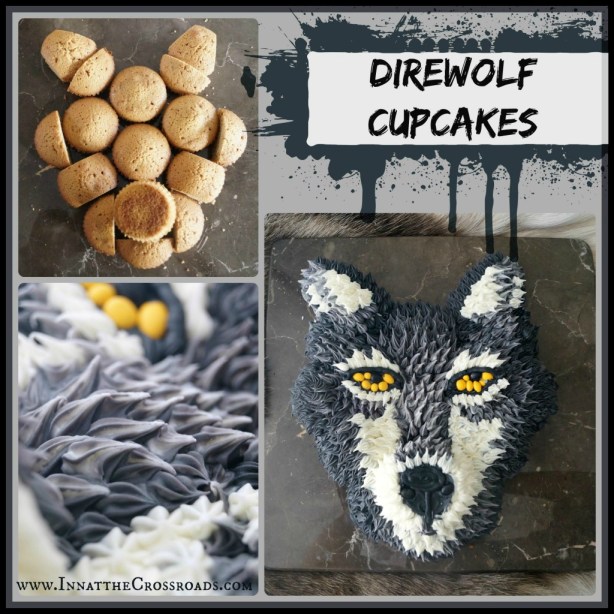
Direwolf Cupcakes

Direwolf Cupcakes, perfect for a S4 Game of Thrones premiere party!

I love a bit of fun for a premiere party, and season 4 is fast approaching!

I’ve wanted to do something like this for a few years now, and this seemed like the perfect time for it. I missed the window for Battle of the Blackwater cupcakes, although I had some pretty epic ideas for those… ;)

With a few exceptions, cupcakes are pretty much cupcakes, tasty and small. The impact of this, though, is the presentation.  Although it looks like a cake, the base of this direwolf is actually made from a bunch of cupcakes, with one flipped upside-down on top of another for the snout. It took a little trimming to get the shape I wanted, but in the end I’m very pleased with the result. It took under an hour to decorate, making it a good candidate for showy party food!

Direwolf Cupcakes Recipe

Cook’s Notes: This is a gingerbread cupcake recipe, but you can use any type you like, or even a mix, if you are pressed for time. For the exact shape I used, you need about 14 cupcakes.

Ingredients:

  • 2 sticks butter, softened
  • 1 cup white sugar
  • 1/2 cup brown sugar
  • 3 eggs
  • 1/4 cup molasses
  • 1 tsp. vanilla
  • 2 tsp. cinnamon
  • 2 Tbs. ginger
  • 1/4 tsp. ground cloves
  • 1 1/2 cups flour
  • 1/2 cup milk

For Decorating:

  • ~4 cups frosting (2 small tubs of storebought)
  • black gel food coloring
  • yellow candy for eyes
  • candy for teeth (look for the bananas from a package of Runts – I couldn’t find any!)

Cream together the butter and sugar, then add the eggs and molasses. Mix until completely combined, then add the spices, followed by the milk and flour. When the batter is all one smooth consistency, spoon into paper-lined muffin tins, and bake at 350 for around 20 minutes, or until a toothpick inserted into a cupcake comes out clean.

Method for decorating:

When I began to lay out the cupcakes for this project, I quickly realized that all round cupcakes was simply not going to work. I pulled the paper off my cupcakes and set to trimming and arranging. Make sure that you have the cupcakes set up on a large plate or cutting board, since they can’t be easily moved once iced. I ending up with this combo:

unfrosted direwolf cupcakes

To make the fur on my direwolf, I used a star tip on my pastry icing bag, and that worked great. The trick to making the frosting fur look layered is to start on the outside and work your way in. That means beginning with the darkest grey, and gradually adding layers as you go to give the look of overlapping fur. For some of the sections, I even used two or three colors, which gave the fur a great striated feel. I looked at a photograph of a real wolf as I went, mostly to help with the colors. When the frosting is complete, you can add the candy for the eyes.

I had extra frosting left over, which I used to quickly ice the sides of the cake, partly for looks and partly to keep the cake fresher.

frosting fur, from direwolf cupcakes, via Inn at the Crossroads

 Direwolf Cupcakes, perfect for a S4 Game of Thrones premiere party!

Flaky Mushroom Pastries – The Gentlemen Bastards Series

“Tivoli settled Locke and Jean in one of the alcoves, on chairs that would have been at home in the suite of false furniture they’d given to Requin. An attendant brought a tray of flaky brown pastries in the western style, filled with cheese and minced mushrooms. They were the richest thing Lock had eaten in weeks.” -Republic of Thieves

Thoughts:

After many months, and several books ahead of it in the queue, I finally got to read Scott Lynch’s Republic of Thieves, and it did not disappoint. The snappy dialogue is again at times laugh out loud funny, and although there are fewer descriptions of food than in the first two books, what descriptions there are made my mouth water.

This is one of those. Simple, easy, and fast to make, this mushroom pastry is full of flaky savory goodness. The mushrooms are the predominant flavor, which is accentuated by the dark ale, garlic, and thyme.

Recipe for Flaky Mushroom Pastries

Ingredients:

  • 1 Tbs. olive oil
  • 1/2 onion, diced
  • 1 Tbs. unsalted butter
  • several large handfuls of mushrooms, roughly chopped (I prefer a mixed pack)
  • 1 clove garlic, chopped
  • ½ teaspoon dried thyme
  • Salt and pepper, to taste
  • ¼ cup dark beer
  • 1 sheets puff pastry, thawed
  • 1 egg, for glaze
  • 1 cup shredded cheese, such as cheddar or gruyere

Preheat the oven to 400F, and line a baking sheet with parchment paper.

Cook the onions and garlic in oil over medium heat until they soften and turn clear, around 5-10 minutes. Add the butter, followed by the mushrooms. Gently sautee until they are soft and covered with butter. Toss in the thyme and other seasonings, and stir for another 30 seconds. Pour over the beer (you can drink the rest for culinary inspiration!) and scrape up any of the tasty brown bits stuck to the bottom of the pan. Continue to cook until the liquid has mostly cooked off. Remove from heat and set aside.

Unfold the thawed puff pastry and cut into half. Place the pastry on the prepared baking sheet. Take a sharp knife and score a line around the outside edge of the pastry, about 1/2″ from the edge. This will allow the edges to puff up as they cook. Brush those edges of pastry with the beaten egg, then spread the mushroom mixture on the inside rectangle of pastry.

Bake for about 20 minutes at 400F, or until the exposed pastry is a lovely golden color. Sprinkle with shredded cheese while still hot, then allow to cool slightly before serving.

Totally Weird Food

This started as an endnote on the Feasts of Epic Proportions post, and grew so out of hand that I had to make a new post for it. Brace yourselves, this isn’t a post for the faint of heart. All I ask is that you never, ever, show this list to GRRM. He’s described a number of strange dishes in his books, and really takes it to a new level in Dance.

However, this real world club put his imagination to shame. Which is fine with me- I’ve met my culinary limits.

Don’t get me wrong, I was the only one in the house to eat honey-roasted crickets, and I actually enjoyed them, but these meals take things to a whole new level. A friend of mine swears that bugs are the food of the future, since they are such a sustainable resource. If that’s the case, I hope I can get mine ground into a smoothie or something.  My entry to this dubious world of bizarre foods came with the list of dishes served at a dinner put on by the Explorers Club in NYC in 1992. It included: 

  • roasted crickets and larvae 
  • mealworm ghanouj 
  • waxworm fritters with plum sauce
  • cricket and vegetable tempura
  • roasted Australian kurrajong grubs to roast beef and gravy. 
  • dessert of chocolate cricket torte
  •  live tarantulas as centerpieces

Now, you might think that this was a one time thing. I mean, the “Explorers Club” puts one in mind of the two adorable kids in the beginning of the film “Up”, with their badges and quest for adventure. But as the club was founded in 1904, they’ve been doing this for decades, and each year, they seemingly try to outdo themselves.

Wildling Special: all you can eat mammoth ribs

I mean, this is the group that served up thawed Mammoth meat in the 50s, and their later dinners are no less extreme. I’ll give you the link to this article, and let you read it for yourself. Seriously, not for the faint of heart. Some of the pictures alone are daunting, and cannot be unseen (there are eyeballs. For martinis…). Granted, some of the dishes are appealing, such as the slow-roasted elk with rosemary potatoes, or the mustard-thyme rubbed rabbit, or even the caramelized yak.  My favorite (might have to make it) are the edible orchids with a honey-creamed dipping sauce. Others sound completely made up, like the ricewine-pickled duck tongue, or jellyfish slivers in white soy marinade. For better or worse, I could see a number of these elements working their way into aSoIaF: Dornishmen nibbling on scorpions, prisoners in the Red Keep munching on roaches, and so on. I’ll spare you the more intense dishes, but in the spirit of things, what’s the strangest thing YOU have ever eaten? Would you take advantage of such a crazy buffet?

Dornish delicacies?

Baked Currant Doughnuts

Baked Currant Doughnuts

 Thoughts:

This recipe is based on one from Clear Flour Bakery, near which I used to live. It makes amazing doughnuts, albeit ones that are still a little inferior to those from the bakery itself. You could get me to wake up at any hour of the morning to get some of those doughnuts. But now living several hours away, getting a hold of the genuine article is no longer practical.

These delectable morning treats have always struck me as oddly medieval. Between those familiar cinnamon and nutmeg, and the prolific currants, they tick several of the standard medieval ingredient boxes. The triple risings make them soft and incredibly fluffy, and I will admit to eating several myself. Every time. They’re SO good. Even the residents of The Inn who don’t especially like sweets enjoy these, since the main sugar content is however much you dust the outsides with.

Proposed Location?

The expense of the spices would point toward one of the more well-heeled households, while the dried currants point toward something somewhat northern. I could see them at Winterfell or Riverrun, but even as far south as King’s Landing or Oldtown. Each location or family cook would probably add their own special ingredients to them, such as candied lemon peel in the capitol, or a dash of rosewater for the Tyrells. And as I type those thoughts, I might have to try some of those variants… strictly for research purposes, you understand. ;)

What do you think would be good?

Baked Currant Doughnut Recipe

Makes about 10 doughnuts

Cook’s Notes: This recipe looks daunting, but the hardest part is waiting for the doughnuts to rise. If I’m serving them with breakfast, I like to start the dough the night before- I let it go through the first rise, then punch it down and leave it somewhere with a neutral temperature to rise the second time overnight. In the morning, all I have to do is form into shapes, let rise the final time, and bake!

Ingredients:

  • 1 cup dried currants
  • 1 1/2 tsp. instant yeast
  • 1/4 cup granulated sugar plus 1 cup for dusting
  • 3/4 cup milk, warmed
  • 3 cups all purpose flour
  • 3/4 teaspoon ground nutmeg
  • 1/4 teaspoon cinnamon
  • 1 large egg
  • 1 stick soft butter, plus 4 -6 Tbs. additional melted butter
  • pinch of salt

In a medium bowl, cover the currants with hot water and let stand until softened, 20 minutes. Meanwhile in a small bowl, stir the yeast with 2 tablespoons of warm water and a pinch of sugar and let stand until foamy about 5 minutes.

In a separate bowl, cream together the butter and sugar. Add the egg, then the yeast and spices. Drain the currants, and stir into the batter. Gradually add the flour, alternating with the milk, until the dough comes together. It should start to take on a smooth consistency that pulls away from the sides of the bowl; if need be, either don’t add all the flour, or add a little extra until you reach the right kind of dough. 
Turn out onto a lightly floured surface, and knead for several minutes, or until the dough bounces back when poked. Grease a large bowl and place the kneaded dough into it. Cover with plastic wrap or a damp towel, and let stand in a warm place until it’s doubled in size. Punch it down, re-form it into a ball, and place back in the bowl. Let it rise again until doubled.
Grease a couple of baking sheets with butter. Divide your dough into 10 pieces, and pinch them into ball shapes. Split these between the baking sheets, flattening them slightly. Using a small round cutter, cut out the center of each disc of dough and place in the empty spaces on the baking sheet. Cover the dough again, and let rise  in a warm place for one final hour.
Bake at 400F for about 20 minutes- the doughnut holes might need less time, so keep an eye on them. The doughnuts are done when they are a rich golden color. Remove from oven, allow to cool for a few minutes until they can be handled, then brush with melted butter and dip in granulated sugar. Dig in!

Roman-Style Tenderloin, with bacon and sage

Tenderloin

Thoughts:

It’s another virtual potluck, AND a recipe from one of my favorite medieval cookbooks, The Opera of Bartolomeo Scappi.  It reminds me of a Turkish dish I once had, called Çöp Şiş, where the meat on the kebab was spaced out with chunks of fat. It tasted amazing, and this is similar.

The bacon adds flavor to the tender beef. When I eat bacon, I like it like Tyrion: burnt and crispy, so in the future I would like to try using salt pork or some other type of cured pork. I used bay leaves, which imparted a great flavor, and I imagine sage would do likewise; I hope to try it in the near future… Yom. :)

This dish comes from Kate Quinn’s newest novel, the Lion and the Rose, the second in her series about the Borgias. Check out the other dishes in this virtual potluck below:

  • Taking On Magazines, Venison in Brandy-cream sauce, Tortellini with basil-parsley filling
  • Between the Sheets, Stuffed Endives, Blood Orange Torte
  • Island Vittles, Potato Chips and Candied Walnuts
  • Little White Apron, Beef en Brochette with Blood Orange, Fennel and Olive Salad
  • Lost Past Remembered, Fish Pie with Orange
  • Kate Quinn, Walnut and Pecorino Cheese Torte

Roman-style Tenderloin Recipe

Get the leanest part of the tenderloin, with the bones, skin, and gristle removed, and cut it crosswise in six-ounce pieces, sprinkling them with ground salt and fennel flour or coriander ground with common spices. Into each piece, set four lardoons of marbled salt pork. Place them in a press with that mixture and a little rose vinegar and must syrup for three hours. Then mount them on a spit with a rasher of bacon and a sage or bay leaf between each piece; cook them over a moderate fire. When they are done, they need to be served hot, dressed with a sauce of their drippings together with the compound that exuded from them in the press, which sauce should be somewhat thick and saffron-coloured. -The Opera of Bartolomeo Scappi

  • 2 beef tenderloins, of hefty thickness
  • bacon or salt pork, cut into squares
  • 1/2 cup must syrup, or grape juice
  • 1/4 cup rose vinegar
  • sage or bay leaves
  • 1 tsp. fennel pollen
  • hefty pinch salt
  • 1/4 tsp. black pepper

Cut the tenderloin into large chunks. Place these in a deep dish, then pour the must syrup/grape juice, the vinegar, and the spices over. Press the meat down, and let marinate for several hours. Then, slide the meat onto long skewers, adding bacon and sage or bay leaves intermittently. Broil on low for just long enough for the meat to be done, turning once in the middle, about 15 minutes. Cover to keep warm, and cook the drippings and the marinade until it thickens.

Cookbook Cover Crown Roast

 Crown Roast Pic

Thoughts:

I’ve had a few inquiries since the cookbook came out about the beautiful and mouthwatering crown roast on the front cover. No wonder, since it’s so striking:   (photo)   However, I have a secret to confess. Until now, there was no recipe to go with that dish, either in the cookbook or on the blog. Finally, I’ve decided to fix that. When Sariann and I went to do the cover photo shoot, we had to make a lot of food. Like, a few days’ worth of cooking; We didn’t know what would get used, so we brought a bit of everything. I had hoped to bring a version of the rack of lamb with garlic/herb crust, but lamb was just too expensive for a dish that might not get eaten after hours under photography lights. If I buy lamb, I want to eat every last bit of it. So I bought a rack of beef ribs much more inexpensively, and trimmed them to look fancy. It worked, but leaves me hungry every time I look at the cookbook. Thus, this new suggestion for a future aSoIaF book- the crown roast.

While the cookbook cover roast was predominantly for show, this version begs to be eaten. The bacon around the bottom keeps it juicy and delicious, while the stuffing finishes cooking to be dense and filling. The meat pulls flavor from the bacon on the outside and the stuffing on the inside. While the meat wasn’t quite fall-off-the-bone tender, it was pretty close.

Why it should be in the next book:

It’s a crown. Made of meat. Wrapped in bacon. Tell me that some witty Westerosi cook wouldn’t serve something like this at, say, a coronation feast. It’s also a perfect centerpiece for your S4 premiere parties, because who doesn’t love gnawing on a bone at a medieval feast? (vegetarians excepted…)

Crown Roast Recipe

Time: ~2 hours       Serves: depends on the size! figure 2-3 ribs per person, with additional sides

Ingredients:

  • 1 rack of ribs, your choice of meat (I used pork)
  • salt and pepper
  • Stuffing (get the recipe)
  • ~5 strips of Bacon

French the ribs, if your butcher can’t/won’t. Do this by trimming down the meat around the tops of the ribs to leave about an inch of exposed bone. This is just to make it look fancier, like in the picture, but if you’re pressed for time, you could skip it. Save the trimmed bits of meat, taking care to check each for small pieces of bone. Curve the trimmed rack around on itself so the rib ends are pointing up and out, then secure the two ends together with a bit of twine or toothpicks (if you use toothpicks, remember to warn guests before serving).

Wrap two or three strips of bacon around the bottom of the crown roast. Fry the remaining bacon, dry, and crumble into the stuffing. Brown the leftover bits of trimmed meat from the top of the roast in the bacon fat, then add it to the stuffing mixture. Press the stuffing into the middle of the crown. Cover the stuffing with tin foil, and cook the roast at 375 for around 2 hours. If you like, remove the foil about 20 minutes from the end of cooking to allow it to brown.

To serve, cut into small rib sections, and dish up with some of the stuffing. If you like have a little of your favorite sauce available on the side.

Here’s to 2013…

The Iron Throne comes to Boston

What a year this has been, readers.

First and foremost, I want to thank each and every one of you for your continued support, enthusiasm, and photos throughout the past year. Seeing how you incorporate Westerosi and medieval recipes into your holidays and viewing parties never ceases to delight me. Food is an invaluable way to bring people together, and it’s a joy to see so many of you enjoying it with friends and family.

I’d also like to thank you for your patience with the increasingly sparse posts during the past few months. The planets properly aligned, leading to a number of wonderful things: At the end of summer, I was fortunate enough to be able to unexpectedly buy an old farmhouse in Vermont, and have been working to get it back into the shape it deserves. That involves a little carpentry, a bit of creativity, and a lot of stripping 70s era wallpaper. It’s hugely gratifying, but time consuming. In November, I won NaNoWriMo, and threw my first Thanksgiving.

And then over the holiday, I got engaged. That’s right. As of now, I’m planning a wedding feast (no Freys or Lannisters invited, thanks), hopefully with a barrel of cider and a giant pit-roast. The cake, of course, could be nothing except lemoncake.

We also have a cadre of rescue animals, and are planning to tear down the ceiling of the kitchen (there are beams up there!). Life’s been crazy, and I very much miss all the wacky cooking for my blogs. I have a number of amazing recipes to try out, just waiting in the wings; I’m especially looking forward to Stargazey Pie…

That was a lot about me, all of which is to say: You are all great. Food is wonderful. Check back in the new year for some exciting new blog developments and new recipes. With all this additional house-space, I’ve got all kinds of schemes up my sleeves. :)

A Dishful of Snowe

Dishful of Snowe, c. 1545

Thoughts:

This is a fun, medieval, glorified version of  whipped cream that is intended to look like fresh snow. The addition of beaten egg whites stiffens the mix beyond the texture of ordinary whipped cream. The flavor is only slightly sweet, although you could add more sugar to taste. The hint of rosewater is what makes this light and fluffy dish especially unique. Although originally a dessert dish in its own right, to our modern sensibilities, it’s more like a topping. Personally, I think this would make a great addition to any wintery feast, and would look especially fitting next to a nice chocolate yule log. It can accompany any dish with which you would serve whipped cream. 

For more of a dessert dish, check out this other recipe for Apple Snow, c. 1880.

A Dishful of Snow

Prep: 15 minutes         Makes 4 plus servings     


To make a dissh full of Snow. Take a potell of swete thicke creame and the whites of eight egges & beate them al togider with a spone / then put them in youre creame and a saucer full of Rosewater and a disshe full of Suger with all / than take a sticke & make it cleane / and than cutte it in the ende foure square / and there with heate all the aforesayde thinges togither / & ever as it ryseth take it of and put it into a Collander / this done / take one apple and set it in the myddes of it and a thicke busshe of Rosemary and set it in the middes of the plater / then cast your Snow upon the Rosemary & fyll your platter therewith. And if you have wafers cast some in with all and thus serue them forth. -A Propre new booke of Cokery, 1545

Ingredients:

  • 1 pint heavy cream
  • 2 egg whites
  • 1 tsp. rosewater, or more to taste
  • 2 Tbs. sugar, or more to taste
  • rosemary and apple, for garnish

Combine the cream, egg whites, rosewater, and sugar in a bowl. Beat with a mixer until the mixture thickens substantially and begins to resemble a fluffy snow. Scoop into a colander and allow to drain in the fridge for at least five minutes. Decorate a platter with rosemary stalks, then spoon the “snow” on top. Dust with a little extra sugar for sparkle, then place an apple in the middle. Serve immediately. 

Zeppolle and Zabaglione, circa 1570

Medieval Zeppole and Zabaglione

Thoughts:

In my ongoing quest to prove that medieval food is not gross, I knew I had to try these two recipes. I discovered the cookbook of Bartolomeo Scappi this summer at a medieval food lab (yep, I’m a dork), and was so diverted by the wonderful recipes in the book that I quickly added a few of them to my queue. You can check out the cookbook itself on Google Books, here.

Although Scappi provides much more detail about his methods of cooking, as well as proportions for ingredients, these recipes fought back a little. It took a few tries, and even now, I’ll probably take another crack at them to try and perfect the recipes. For those unfamiliar with these dishes, they are traditional Italian desserts. Zeppole are like little fried doughnut holes, and Zabaglione is like a thick alcoholic pudding. While I knew they were traditional, I didn’t know they dated so far back as 1570. I imagine they might even go back to Ancient Rome… I’ll take a look.

Medieval Zeppole from Scappi

Medieval Zeppole, from Scappi

As mentioned, the Zeppole need a little work. I followed the recipe very closely, and met with some difficulties. I boiled the chickpeas and chestnuts, which seems now unnecessary, unless you are using dried chestnuts.  The yeast was not sufficient to leaven the dough, so I added the six egg whites suggested at the end of the original recipe, which helped fluff the fritters up. I ground up the nuts myself, which made for a lumpy sort of dough that was prone to falling apart without the eggs. These were the many trials I struggled with in the process of working through this recipe. In the future, I would use a variety of nut flours, rather than the coarsely ground nuts I had, which should result in a more cooperative dough.

Medieval Zabaglione, from Scappi

Medieval Zabaglione, from Scappi

The Zabaglione, on the other hand, is wonderful. Rich and boozy, it’s also somehow also light and fluffy, somewhere between a custard and a mousse. The modern version tends to be plainer, but I love the traditional addition of the cinnamon, which gives it a nice spiciness. This recipe took me two tries to get right, but once I did, it’s an instant house favorite. I omitted the water the second time, and the mixture fluffed up beautifully, just the way it ought to.

One very cool thing about these two recipes is that they are so complimentary. One uses six egg yolks, the other the whites. The flavors and textures go well together, and the result is a tasty dessert pairing worthy of any dinner party.

Medieval Zeppole and Zabaglione

Zeppole Recipe

Makes around 2 dozen small fritters.      Time: around 1 hour

Cook’s Note: I’m putting in the recipe as I made it, but plan to revisit and improve in the coming month or so. You’ll have an easier time if you just use nut flours rather than trying to grind the nuts yourself. Be sure to check back for the update!

Zeppole Ingredients:

  • 1 15 oz. can chickpeas/garbanzo beans
  • 6 oz. chestnuts, shelled
  • 6 oz. walnuts, shelled
  • 4 oz. sugar
  • 1 Tbs. cinnamon
  • 1/2 tsp. combined cloves and nutmeg
  • dash of rosewater
  • optional seasonings: mint, marjoram, burnet, wild thyme
  • 6 egg whites
  • oil or fat for frying (I used Crisco)
  • cinnamon sugar, for dusting

Wash the chickpeas, removing any of the outer skins that peel off. Boil the chickpeas and chestnuts in a light meat broth for 20-30 minutes, until the chestnuts are soft. Strain, then grind together the chickpeas, chestnuts, and walnuts until you have a relatively fine meal or paste. Add the sugar, cinnamon, cloves, and nutmeg, followed by the yeast mixture. If you like, add in some minced herbs to taste. Stir in the egg whites. 

Bring your oil to medium heat. Using a spoon, scoop out about two tablespoons of the batter at a time. gently drop this mixture into the hot oil. They should sink to the bottom of the pan, but then rise to the top as they cook (you may need to loosen them up if they stick to the bottom). Fry for about a minute, until the fritters are a dark golden brown. It may take some time to get the hang of this part, but keep trying!

When the fritters are done, remove to a plate covered with paper towels to drain. Brush each fritter with rosewater and roll in cinnamon sugar.

Zabaglione Recipe

Makes about 6 small servings       Time: ~20 minutes

Zabaglione Ingredients: 

  • 6 egg yolks
  • 6 oz. sweet malmsey
  • 3 oz. sugar
  • 1 1/2 tsp. cinnamon
  • 4 oz. water
  • butter

Combine six egg yolks with the sugar and cinnamon in a medium bowl. Whisk briskly until the sugar has dissolved and the mixture looks like a very pale yellow cream. Add the white wine, whisk to combine, then place the mixture in a bowl over a double boiler, and whisk while it cooks until it is the consistency of a thick pudding. Carefully remove from heat (the bowl is hot!) and stir in the butter. Serve warm, as in the original instructions, or pour into serving dishes and chill for a thicker set.

« Previous Page
Next Page »

Made something?`

If you’ve made a recipe from the blog, be sure to tag your tasty creations with #GameofFood!

Support the Blog!

If you love the content here, please consider becoming part of our Patreon community!

Support the blog by becoming a patron!

Affiliate Disclaimer

Please bear in mind that some of the links on this website are affiliate links, meaning that if you go through them to make a purchase I may earn a small commission. I only include links to my own books, and products I know and use.

CyberChimps WordPress Themes

All content copyright 2024