The Inn at the Crossroads
  • Home
  • About
    • FAQ
    • From Readers
    • About the Author
    • Interviews and Articles
  • Latest Posts
  • Game of Thrones
    • Game of Thrones Recipes, by region
    • Game of Thrones Recipes, by meal
    • The Official Game of Thrones Cookbook
  • Cookbooks!
    • The Official Game of Thrones Cookbook
    • World of Warcraft Cookbook
    • Hearthstone Cookbook
    • Elder Scrolls Cookbook
    • Firefly Cookbook
    • Overwatch Cookbook
    • Star Wars: Galaxy’s Edge Cookbook
    • WoW: New Flavors of Azeroth
    • Star Trek Cookbook
    • Second Game of Thrones Cookbook: Recipes from King’s Landing to the Dothraki Sea
      • Game of Thrones Cookbooks Bibliography
    • Errata
  • Other Recipes
    • Other Fictional Foods
    • Other Historical Foods
    • Everything Else!
  • Contact
    • Sign Up for News!

Category Archives: Sides

Pumpkin Pasties – Harry Potter

“Anything from the cart, dearies?” 

–Harry Potter and the Sorcerer’s Stone, by JK Rowling

Thoughts:

I had a pretty clear idea of what my version of Pumpkin Pasties should be. And now that it’s autumn, there was simply no resisting the tug of pumpkin-based recipes. More on those to come…

These pasties are delicious. Portable, yet moist, they can be easily enjoyed on a train, late summer picnic, lunchbox, or my favorite: slightly toasted for breakfast. With the cinnamon icing, it’s like a giant pumpkiny pop-tart, and I mean that in the very best way (like your 12 year old brain remembers them). It’s also a more straightforward recipe than some, which require double baking the filling. 

Pair them with some cider, hot or cold, and they’re a must not only for your HP viewing parties, but also for all your autumnal gatherings. 


Pumpkin Pasties Recipe

Prep: 15 minutes       Baking: 10-15 minutes       Cooling/icing: 30 minutes

Makes about 10-12 Pasties

Cook’s Notes: Although I wrote these directions for the pie mold I own, it’s easily adapted to suit what you have. See the notes at the very bottom of the post for details. 

Ingredients for Crust:

  • 3 cups flour
  • 1 stick butter (1/2 cup)
  • 1 tsp. salt
  • 1 egg yolk (save the white!)
  • 1/4 cup sugar

Filling:

  • 2 eggs
  • 3/4 cup sugar
  • 1 1 lb. can pumpkin
  • 1/2 tsp. salt
  • 1 tsp. cinnamon
  • 1/2 tsp. ginger
  • 1/4 tsp. cloves
  • 1/2 tsp. allspice
  • 1/2 cup heavy cream
  • 1/4 cup dried currants

Icing:

  • 1 egg white
  • 1 cup powdered sugar
  • 1 tsp. cinnamon
  • water, if needed

Preheat your oven to 350F, and line a baking sheet with parchment.

Make your pastry dough: Mix together the dry ingredients. Rub in your butter, then add the egg yolk and enough cold water to bring the dough together. Set aside.

Mix the filling: Combine all ingredients until they are thoroughly mixed. Set aside.

Divide the pastry dough in half. Roll one half out to a thickness of about 1/4″. Use your cutter to cut out the desired shape. Fill with just enough filling that it won’t eek out the seams. Wet the edges with egg white, and cover with the top piece of pastry. Crimp the edges shut, and transfer the pit to the prepared baking sheet.

Brush the tops of the pasties with a bit of egg white, then sprinkle with cinnamon sugar. Bake for 10-15 minutes, or until the edges of the pasties are golden. Remove from baking sheet and allow to cool completely!

Make the icing: Beat what is left of your egg white until it’s frothy. Add the cinnamon and the confectioner’s sugar, 1/4 cup at a time, until the consistency is thick but drizzleable. If it becomes too thick, thin with a splash of water. Drizzle the icing over the cooled pasties, and serve!

Note: I used a pumpkin shaped hand pie mold from William-Sonoma. I looked and looked online, but for the life of me couldn’t find them for sale anywhere anymore. Instead, I’d suggest this half circle style press from Amazon, which I also have. If you’d like to just fake it, you can use large circles of dough, and crimp the edges with the tines of a fork.

Are these still sold anywhere?

Shortbread Gears

Thoughts:

I saw this cookie press over the summer, and just couldn’t resist. These finished shortbread rounds, despite being a very crumbly dough, come out moist and wonderful. I am partial to cardamom, but you can tweak them with whatever add-ins your clockwork hearts desire. Tasty, flaky, they’re ideal with a tall glass of cold milk, or a cuppa.

My press came from Wandering Wood, a merchant within the SCA. If you’d like to contact them to order your own fabulous press (they do custom work!), you can find them here.

Continue reading →

Meatrolls – Dragonriders of Pern

“Menolly had detoured to the Lower Caverns and shared with him the handful of meatrolls she’d cadged from the cooks.”

–Dragonriders of Pern, by Anne McCaffrey

Thoughts:

These are terrible. A curse, in that, so-easy-to-make addictive sort of way. 

I made a single batch, and they were gone in minutes. I couldn’t make out all the words around the mouthfuls, but from the wild gesticulations, and later exhortations to  please make them again, they seemed to be a great success with the test subjects.

You can use whatever variety of sausage you like. I happened to have some wild boar sausages handy, and they suited the recipe admirably. If you can get game sausage of any kind, it’s definitely worth a try, as they help defamiliarize the experience. In any case, the resulting combination of puff pastry (how could you go wrong?) and juicy sausage is a long tried and much loved pairing. The outer pastry shell stays flaky, while the inside soaks up some of the flavorful juices from the meat. 

This recipe also has the added appeal of making small enough meatrolls that they would be snitchable from the kitchens of castle, fortress, or cottage, as Menolly proved in the books. Double win!


Pernese Meatroll Recipe

Prep: 5 minutes          Baking: 20 minutes

Makes 12 rolls (it won’t be enough!)

Ingredients

  • 1 lb. package pork sausagemeat
  • 1 (17.25 ounce) package frozen puff pastry sheet, thawed
  • 1 beaten egg
  • poppy or sesame seeds (optional)

Preheat the oven to 400 degrees F, and line a baking sheet with parchment paper.

Unfold the sheets of puff pastry, and cut lengthwise down the middle. Make five more cuts width-wise so you have 12 long pieces total. Divide the sausage meat evenly between the strips of dough, then seal the ends together with a swipe of egg.

Arrange the sausage rolls on the prepared baking sheet. Brush with egg, and sprinkle with seeds. Bake for around 20 minutes, or until they’re puffed up and a nice golden brown. Allow to cool slightly before serving.

Dothraki Blood Pie

Traditional Blood Pie

“Food was brought to her, steaming joints of meat and thick black sausages and Dothraki blood pies, and later fruits and sweetgrass stews and delicate pastries from the kitchens of Pentos…” -A Game of Thrones

Modern Blood Sausage Tart

Thoughts:

*Fun Fact: Blood Pie is also a Klingon Dish. Oh, the wonders of the interwebs…*

The traditional pies are great. Rustic and hearty, frying leaves the dough wonderfully chewy, and the insides bursting with flavor. If you are wary of the blood sausage, you needn’t be; One of our housemates ate four of the pies in quick succession, raving about them, and was shocked to learn that they contained black pudding. The spices further improve what would be a wonderful recipe on its own. I used Aleppo pepper, and loved the middle eastern spiciness of it. If you too add spicy pepper to your filling, then you may find that our Milk Tea is a wonderful counter to that heat.

The modern pie is amazeballs. Truly. It took me about three glorious bites to even be able to think about additional adjectives. The smidge of garlic on the bottom of the filling was planted, grown, and harvested purely to complement the chevre.  The leek was lovingly tended by orphans of the Greenblood who sang to it daily, until the time came for it to join the other ingredients in this tart. The black pudding, the center of the whole dish, stands firm amidst the other flavors, allowing them to complement, rather than overpower it. You may think the addition of the pistachios strange, but they lend a bit of crunch to an otherwise creamy dish, and help bring out the subtle nuttiness of the crust. Nibbled on its own, the crust has a nice, dry earthiness. However, it softens as it soaks up moisture from the filling, and adds to the overall gloriosity of the whole.

The two recipes are too dissimilar to compare fairly. I loved them both equally, albeit for their separate merits. I’d say that the traditional pie is the most Dothraki, but although the modern tart moonlights as a dainty and proper dish in its fluted tart pan, it’s absolutely one that Ser Jorah could dig into with both hands. Since most black pudding comes in 1 lb. packages, I suggest making both!

Feast like the Dothraki…

Leche of Brawn

Leche of Brawn

“Tyrion was toying with a leche of brawn, spiced with cinnamon, cloves, sugar, and almond milk, when King Joffrey lurched suddenly to his feet. ‘Bring on my royal jousters!’ he shouted in a voice thick with wine, clapping his hands together.” -Storm of Swords

Our Thoughts:

It’s slightly unclear as to what exactly a leche of brawn was to the medieval diner. It seems to have evolved from once being a simple cut of pork to what we know as brawn, or today as headcheese, sometime between the Middle Ages and Victorian Age. We’ve opted for an historical version of the brawn, and in order to keep the disembodied craniums in the kitchen to a minimum, have made only one version. Perhaps there is a modern version in our future, who knows!

With a binding aspic similar to that used in our jellied calves’ brain recipe, this dish is salty, savory, and sweet at the same time. Essentially a rustic, primitive version of a mortadella, the brawn is perhaps not the first choice for out modern palates, but it is easy to see why this would be an historical staple food. Cheap to make, packed with nutrients, and essentially self-preserving, a brawn like this would be gold in a medieval kitchen. George’s addition on non-traditional spices and accompaniments (cinnamon, cloves, almond milk) gave our Victorian recipe a decidedly medieval turn toward the unexpectedly sweet, adding another layer of complexity to the dish.

  Continue reading →

Mustard recipe from Oldtown

Roman Mustard

“‘There’s cold beef in the kitchens. And mustard in a big stone jar, from Oldtown.’ The thought of that mustard made the old woman smile.” -Feast for Crows

Modern Mustard

Our Thoughts:

I have a confession to make.

I don’t actually like mustard.

I’ve tried to cultivate an appreciation for it over the years, but without any great success. Thankfully, the Inn is filled with mustard fiends, all of whom were more than happy to be tastetesters for this particular post.

Because it is hand ground, the Roman mustard is very coarse, with a bit of a crunch lent it by the larger pieces of mustard seed. The ground nuts combined with the vinegar and honey to make a sort of binder for the seeds, tying the whole condiment together. The resulting spread has a notable bite to it, and is deliciously rustic. Even I could learn to love it.

The modern mustard also has a bite, but like any good mustard, the bite is not cumulative. Not as coarse as many imported French mustards, it has just enough graininess to give it a pleasant old world feel. Rich and profoundly mustardy, it i  Is particularly delicious with a sharp cheddar, and would pair brilliantly with ham. It tastes like an expensive blend from a rural farmer’s market, one that you would have no regrets about purchasing.


Roman Mustard Recipe

[204] MUSTARD BEANSALITER: FABACIÆ EX SINAPI[The beans previously cooked are seasoned with] CRUSHED MUSTARD SEED, HONEY, NUTS, RUE, CUMIN, AND SERVED WITH VINEGAR. – Apicius

Ingredients:

  • 1 cup black or brown mustard seeds
  • 1/2 cup almonds, chopped fine
  • 1/2 cup pine nuts, chopped fine
  • 2-3 teaspoons salt
  • a pinch of cumin
  • honey to taste (I used about 2 Tbs.)
  • 1 cup cold water
  • 1/2 cup red wine vinegar

Grind the whole mustard seeds for a few seconds in a spice or coffee grinder, or by hand with a mortar and pestle. You want them mostly whole. Add the chopped nuts and grind into a paste. Move everything to a bowl and add the salt, cumin, honey, and cold water. Mix well and let stand for 10 minutes. Pour in the vinegar and stir well. When the vinegar is incorporated, pour into a glass jar and store in the fridge. Wait at least 24 hours before using. Mustard made this way will last several months in the fridge.

Modern Mustard Recipe

  • 1/2 cup yellow mustard seeds
  • 3 Tablespoons dry mustard
  • 1 cup water
  • 3/4 cup tarragon vinegar (or any other herb vinegar)
  • 1 Tablespoon honey
  • 2 teaspoons salt
  • 2 Tablespoons chopped fresh thyme (or any mixture of fresh herbs that you enjoy)

Put the seeds, dry mustard, and water in a bowl.  Let this mixture stand 2 hours or until the seeds become soft.  Stir mixture every 15 minutes or so. When the seeds are soft, put the mixture in the food processor and run until the mixture is smooth.  This took about 5 minutes.  I wanted some texture to remain in my mustard so I left some seed pieces. Add the vinegar, honey, salt and herbs.  Place in a lidded jar and allow to stand at room temperature to mellow.  This mixture will be very hot.  Once the mustard is to your taste (mine took about 1.5 hours) keep it in the fridge.  It will keep in the fridge for several months, but could be stored if you choose to use the proper canning technique.


Peppers with Almond-Spinach Filling – The Lies of Locke Lamora

Another dish from Locke Lamora’s Welcoming Meal, these stuffed peppers cook just long enough to still have crunch but also some give. The filling, though, is what really makes the dish. Grainy with a bit of give, it almost resembles a somewhat dry couscous in texture. The flavors of the almond and spinach surprised me with how well they combine, and the pine nuts give it a little nudge towards complexity. The pepper serves mostly as a vessel for this amazing stuffing, but oven roasting softens it a bit, and a bite of pepper along with stuffing will not disappoint. 

The stuffing recipe also lends itself well to an alternative pesto. Simply add another cup or so of spinach, and enough olive oil to give the whole mixture a smooth, spreadable consistency.  Or, for a quirkier hummus, add a can of chickpeas to the mix, and puree.

Really, the options are as limitless as your imagination.

Peppers with Almond-Spinach Filling Recipe

Prep: 15 minutes           Baking: 45 minutes

Makes: 4 stuffed peppers

Ingredients: 

  • 1/4 cup pine nuts
  • 1 clove garlic, roughly chopped
  • 3 cups blanched almonds
  • 1/3 cup olive oil
  • 1 tsp salt
  • 3 cups baby spinach
  • 4 smallish red bell peppers
Preheat oven to 350 F. 
In a medium saucepan, combine all ingredients except the spinach and peppers. Cook over medium heat for 2-3 minutes. Add spinach, turn off heat, stir for 30 seconds until the leaves are coated with oil and limp.
Carefully transfer the hot mixture into a food processor and puree. Depending on the consistency, you may need to add extra olive oil and/or scrape down the sides to ensure it’s all mixed thoroughly.
Cut the tops off your peppers, and remove the seeds. Divide the stuffing equally between the four peppers, and arrange in a baking dish. Bake in oven at 350 for 45 minutes, at which point the peppers should be starting to wrinkle at the edges.
Allow to cool slightly before serving or eating.
 Like this recipe? Check out the other recipes from the Gentlemen Bastards series!

Cod Cakes

Roman Cod Cakes

“The wedding guests gorged on cod cakes and winter squash, hills of neeps and great round wheels of cheese, on smoking slabs of mutton and beef ribs charred almost black…” -A Dance with Dragons

Modern Cod Cakes

Our Thoughts:

The Roman cod cakes are quirkier than what we’re used to when we think of fish cakes, but they’re also quite good. The cod is a nice, mild white fish, which lets the other flavors and textures have a turn in the spotlight. The cilantro is not overpowering, and the wine imparts a subtle sweet flavor. The leeks give an overall crunchiness, while the occasional caper provides a pop of vinegar. We weren’t great fans of the sauce, however; It’s a little too peculiar a pairing for our taste!

The modern cakes were excellent. Just a little crispy on the outside, but with a moist cod-potato filling on the inside. A little salt and a dash of lemon complete the meal, and they’re equally good right out of the frying pan as they are straight from the fridge.

Winner? I’m really not sure. The modern cakes win for general likeability, but the Roman cakes are unique and special. My personal ideal might be a combination of the two, with turnips swapped in for the spuds, and the sauteed leeks added in.


Historical Cod Cakes Recipe

Minutal marinum: pisces in caccabum, adicies liquamen, oleum, uinum, cocturam. porros capitatos, coriandrum minutatim concides, isiciola de pisce minuta facies et pulpas piscis cocti concerpis, urticas marinas bene lotas mittes. haec omnia cum cocta fuerint, teres piper, ligusticum, origanum, fricabis. liquamen suffundes, ius de suo sibi, exinanies in caccabum. cum ferbuerit, tractam confringes. obligas. cum ferbuerit, agitas. piper aspargis et inferes. [Place the fish in a saucepan, add broth, oil, and wine. Also finely chop leek heads and coriander. Form it into small cakes, adding capers and well-cleaned sea nettles. These fish cakes cook in a liquor of pepper, lovage, and crushed oregano, diluted with broth and the above fish liquor. Skim well, bind, stir over the cakes, sprinkle with pepper and serve.] – Apicius, 4th Century

Cook’s Notes: Sea Nettle is a jellyfish. Although there were a few washed up on the beach when I went to photograph the dish, I left out it out for simplicity’s sake. I also opted for the more traditional route of frying the cakes, as they fell apart completely when I tried to cook them strictly according to the recipe.

Ingredients:

  • 1/2 lb. cod, cut into large chunks.
  • 1/2 cup broth
  • 1 Tbs. olive oil
  • 1/2 cup wine (I used a semi-sweet red)
  • 1 leek, diced
  • 1-2 Tbs. fresh cilantro, diced
  • 2 Tbs. capers
  • 2 eggs
  • 1/2 – 1 cup breadcrumbs
  • olive oil for frying

For sauce:

  • pinch of pepper
  • 1 tsp. lovage root
  • 1 tsp. oregano
  • remaining broth, from above
  • roux (1 Tbs. oil, 1 Tbs. flour)

Poach the cod in the broth until it is flaky, around 5 minutes.  Fish out the cod, place in a bowl, and crumble. Add the leek, cilantro, and capers, then the eggs and 1/2 cup breadcrumbs. Mix this thoroughly by hand, and try to make a few patties with them. Add more breadcrumbs as needed.

Once you have a consistency that will work, form the mixture into cakes and fry in oil over medium heat. The cakes should be golden brown, and just a tad crispy. Place on a plate covered with paper towel to drain.

To the poaching broth, add lovage, oregano, and pepper. Simmer until this sauce has reduced slightly, about 5 minutes. Strain, then thicken with a roux.

Serve cod cakes while still warm, with sauce on the side, or drizzled over.

Modern Cod Cakes Recipe

Cook’s note: This recipe is “modern” because of the inclusion of potatoes, a decidedly non-Westerosi ingredient.

Ingredients:

  • 1 lb of cod fillets
  • 2 medium-sized russett potatoes
  • 1 cup bread crumbs
  • 1/4 cup chopped fresh parsley
  • 2 Tbsp freshly grated Parmesan cheese
  • 2 garlic cloves, finely chopped
  • 1 teaspoon salt
  • 1/2 teaspoon pepper
  • 2 eggs, lightly beaten
  • Grapeseed oil, or other high smoke point oil such as canola oil, for frying

Boil and mash the potatoes, set them aside. Boil the codfish until it flakes easily. Drain and flake the fish with a fork. Be sure to remove all bones. Mix the flaked fish, the potatoes and the rest of the ingredients together well by hand. If the mixture is too crumbly, add another egg. If too sticky, add some more bread crumbs. Form the mixture into cakes and fry them on medium high heat in a skillet coated with oil, until nice browned on one side, then flip them over and continue to cook until well browned on the other side. Yield: Makes 12 fish cakes. Serves 4-6.

Welsh Rabbit – The Hobbit

Thoughts:

Although the dish can be sourced back to the early 1700s, the origin of the name is unclear. In any case, this is the ultimate Bag End variety of grilled cheese, this recipe is equally well suited to the savory spread of First Breakfast, or the mouthwatering array of Dinner.

The basic concept is that one combines cheddar, beer, and mustard, fluffs it up with some egg, then broils the whole thing on slices of toast. The resulting snack provides a wonderful array of textures, from the crunch of the toast to the rich, fluffy give of the topping. The taste is reminiscent of beer mustard on a pretzel, although the choice of a darker rye bread gives the whole dish a wonderful, rich earthiness that perfectly suits those agricultural savvy hobbits.

Welsh Rabbit Recipe

Ingredients:

  • 2 Tbs. butter
  • 1 shallot, sliced thin
  • 1 cup grated cheddar
  • 1/3 cup ale or lager
  • 1 tsp. mustard
  • pinch of salt
  • 2 eggs, lightly beaten
  • 4 slices of bread, your choice
  • black pepper

Melt the butter in a saucepan, then add the shallot until it has softened. Add the cheddar, ale, mustard, and salt. Stir over low heat until the cheese has just melted. Add the eggs and stir until the mixture has slightly thickened, around 2 minutes. Be sure to not overcook, or you’ll end up with scrambled eggs!

Toast the bread, then spoon the cheesy mixture over the top of the toast. Cook under a hot broiler until the top is puffy and golden. Sprinkle generously with black pepper, and serve. 


Olla Podrida – Don Quixote, 1655

Olla Podrida

Don Quixote – by Miguel de Cervantes – 1615

“‘That big dish that is smoking farther off,’ said Sancho, ‘seems to me to be an olla podrida, and out of the diversity of things in such ollas, I can’t fail to light upon something tasty and good for me.'”

Thoughts:

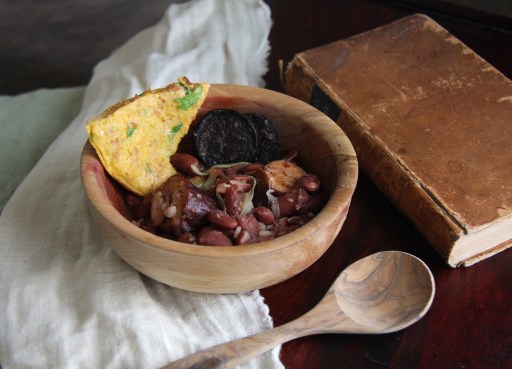
Olla Podrida is a kind of Spanish stew, the base of which is usually pork and beans, but can include any variety of additional ingredients. Although the exact meaning of the name is a matter of some dispute, a fairly safe translation might be “Hodgepodge”. Such a popular dish was it in the 17th and 18th centuries that it was not only mentioned in Samuel Pepys’ diary, but also in Robert Burns’ “Ode Tae a Haggis”. Quirky!

My recipe is from a Spanish reader of the blog, but I have taken the liberty of adding leek, and tweaking the seasoning to my own tastes. The resulting the broth is relatively light, but complex and hearty, although that seems like an impossible contradiction. The spiciness of the chorizo gives it a bite that is neither instant nor cumulative. In this way you can enjoy the full flavors of the broth, followed by a long pleasant heat.

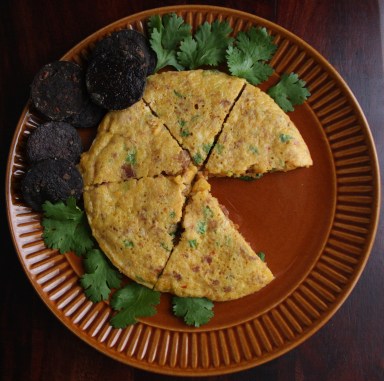
The egg, called a tortilla in Spain, is the perfect accompaniment to the stew; not quite like an omelette as we know it, nor yet quite like a fritatta, the texture is hearty, yet somehow still fluffy and reasonably light. The small amount of chorizo mixed in with the other ingredients calls to the spicy sausage in the stew, and the pairing of the tortilla along with the blood sausage makes it a meal, rather than just soup.

Olla Podrida Recipe

Prep: 1 hour           Cook Time: ~2 hours

Serves 6 

Cook’s Note: The stew is served alongside the blood sausage and the egg tortilla. Be careful with the salt–the chorizos and the morcilla will salt the stew fair enough but better to taste it and correct.

Ingredients:

  • 1 lb. red beans, soaked in water overnight
  • 1 little pig’s trotter
  • 1/5 lb. Salt Pork, rinsed
  • 3 chorizos
  • 4 cloves of garlic, roughly chopped
  • 1 leek, white part sliced thinly
  • salt to taste
  • 1 blood sausage, preferably Burgos Morcilla
  • cumin and thyme to taste (optional)

For the egg tortilla:

  • 3 eggs
  • a few springs parsley
  • 1 clove garlic, minced 
  • 1/3 cup breadcrumbs
  • 1/2 cup olive oil
  • Salt and paprika to taste

Soak the beans in water overnight.

Add the soaked beans, water, and all remaining ingredients except the blood sausage and filling to a stock pot, and cover with a couple fingers’ width water. Cook over low heat for an hour and a half.

Take out the trotter and the chorizo; discard the trotter and grind one of the chorizos finely. Chopp the other two chorizo into rough chunks and add back into the stew. Be careful doing so, as the sausages will be hot!

In a separate pan, beat together the eggs and the other ingredients for the tortilla, adding the ground chorizo from the step above.  Scramble all of this together, and cook in a fritatta pan; if you haven’t got a fritatta pan, you can improvise flipping the tortilla with a dinner plate placed over the omelette. Cut into 6 equal slices.

 Slice the blood sausage and fry in olive oil. Set aside along with the tortilla.  If you would like your stew thicker, make a roux by adding  just under 2 Tbs. flour to 2 Tbs. oil over medium heat. Cook until the flour turns a pretty golden color. While whisking, add a ladelful of broth to the pan- this mixture will thicken almost immediately. Add more broth until the thick roux is pourable, at which point add it back into the stew.

 Season to taste, adding cumin and thyme as desired. Serve hot with the tortilla  and blood sausage on the side. 

Enjoy!

« Previous Page
Next Page »

Made something?`

If you’ve made a recipe from the blog, be sure to tag your tasty creations with #GameofFood!

Support the Blog!

If you love the content here, please consider becoming part of our Patreon community!

Support the blog by becoming a patron!

Affiliate Disclaimer

Please bear in mind that some of the links on this website are affiliate links, meaning that if you go through them to make a purchase I may earn a small commission. I only include links to my own books, and products I know and use.

CyberChimps WordPress Themes

All content copyright 2024