
The Inn at the Crossroads
  • Home
  • About
    • FAQ
    • From Readers
    • About the Author
    • Interviews and Articles
  • Latest Posts
  • Game of Thrones
    • Game of Thrones Recipes, by region
    • Game of Thrones Recipes, by meal
    • The Official Game of Thrones Cookbook
  • Cookbooks!
    • The Official Game of Thrones Cookbook
    • World of Warcraft Cookbook
    • Hearthstone Cookbook
    • Elder Scrolls Cookbook
    • Firefly Cookbook
    • Overwatch Cookbook
    • Star Wars: Galaxy’s Edge Cookbook
    • WoW: New Flavors of Azeroth
    • Star Trek Cookbook
    • Second Game of Thrones Cookbook: Recipes from King’s Landing to the Dothraki Sea
      • Game of Thrones Cookbooks Bibliography
    • Errata
  • Other Recipes
    • Other Fictional Foods
    • Other Historical Foods
    • Everything Else!
  • Contact
    • Sign Up for News!

Category Archives: Fictional

Cinderella – Edible Mice


A thoroughly compelling rags-to-riches story, Cinderella has inspired countless films, ballets, books, and songs. I went on a brief fairytale/Disney kick when I got home from Walt Disney World last winter, and am just now getting back to finishing off a few of those posts.

The earliest type of Cinderella story dates as far back as the ancient Greeks, and the account by Strabo in the 1st century BCE. In that story, a large eagle drops a beautiful sandal into the lap of a king, who searches the lands until he finds the woman to whom it belongs. The Chinese version from 860 involves a magical fish, but also has the crucial lost slipper element. The first Italian version, Cenerentola, was published in 1634, followed by Charles Perault’s in 1697, which first introduces the glass slippers. The Brothers Grimm didn’t write their version, “Aschenputtel”, until the 19th century, in which the fairy godmother is actually a magical tree. WILD. 

Like so many of the older stories, the Disney version of this classic tale involves crucial help from animals, most notably mice. These peanut butter mice are so gobbleable that they won’t last long! These were a favorite snack of mine as a child, and I still occasionally indulge. ;)

Edible Mice Recipe

Note: This version doesn’t include a tail, but there are many varieties of candy that could easily fit the role. 

 Prep: 20 minutes  *  Chilling: 1 hour

Yield: 10 to 12 mice

Ingredients:

  • 1 cup creamy peanut butter
  • 1 cup powdered milk
  • 1/2 cup honey
  • sliced almonds, for ears
  • sprinkles, for noses
  • 1 cup cinnamon sugar, or 1 cup white or dark chocolate chips, for dipping (optional)

Mix the peanut butter, dry milk, and honey together in a medium mixing bowl. Roll into small balls, about the size of a large marble, then pinch into teardrop shapes. At this point, either leave them plain, or roll in cinnamon sugar. Press a sprinkle onto the point of the teardrop for a nose, then insert two almond slices for ears. Make the eyes with a toothpick. You may also press the shape of a curling tail into the back of the mouse using a toothpick.

To cover with chocolate, place the plain balls in the refrigerator for at least an hour to chill. Line a baking sheet with wax paper. Melt the chocolate in a small bowl in the microwave, then nestle it in a slightly larger bowl filled with hot water. Remove the mice from the fridge, and dip them one at a time in the chocolate, allow the excess to drip off, then place them on the wax paper. Before the chocolate sets, add the nose and ears, using a knife to make a small hole for the ears in the chilled peanut butter, if necessary. Once the chocolate is set, gently poke holes for eyes with a toothpick, and if you like, drizzle a little extra chocolate on the back for a tail.
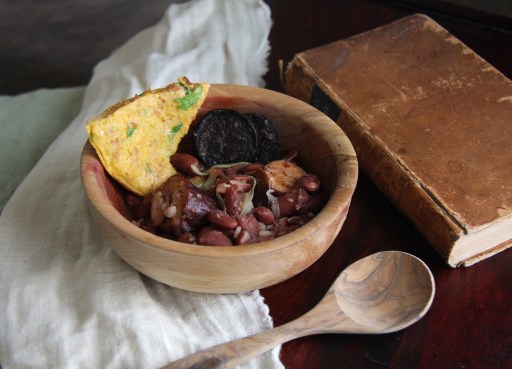
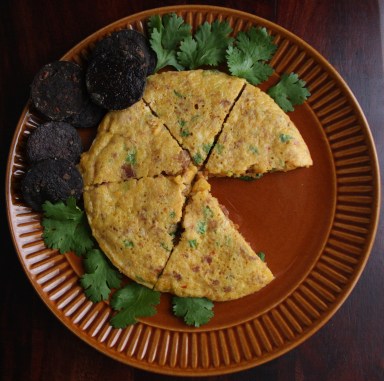
Olla Podrida – Don Quixote, 1655

Olla Podrida

Don Quixote – by Miguel de Cervantes – 1615

“‘That big dish that is smoking farther off,’ said Sancho, ‘seems to me to be an olla podrida, and out of the diversity of things in such ollas, I can’t fail to light upon something tasty and good for me.'”

Thoughts:

Olla Podrida is a kind of Spanish stew, the base of which is usually pork and beans, but can include any variety of additional ingredients. Although the exact meaning of the name is a matter of some dispute, a fairly safe translation might be “Hodgepodge”. Such a popular dish was it in the 17th and 18th centuries that it was not only mentioned in Samuel Pepys’ diary, but also in Robert Burns’ “Ode Tae a Haggis”. Quirky!

My recipe is from a Spanish reader of the blog, but I have taken the liberty of adding leek, and tweaking the seasoning to my own tastes. The resulting the broth is relatively light, but complex and hearty, although that seems like an impossible contradiction. The spiciness of the chorizo gives it a bite that is neither instant nor cumulative. In this way you can enjoy the full flavors of the broth, followed by a long pleasant heat.

The egg, called a tortilla in Spain, is the perfect accompaniment to the stew; not quite like an omelette as we know it, nor yet quite like a fritatta, the texture is hearty, yet somehow still fluffy and reasonably light. The small amount of chorizo mixed in with the other ingredients calls to the spicy sausage in the stew, and the pairing of the tortilla along with the blood sausage makes it a meal, rather than just soup.

Olla Podrida Recipe

Prep: 1 hour           Cook Time: ~2 hours

Serves 6 

Cook’s Note: The stew is served alongside the blood sausage and the egg tortilla. Be careful with the salt–the chorizos and the morcilla will salt the stew fair enough but better to taste it and correct.

Ingredients:

  • 1 lb. red beans, soaked in water overnight
  • 1 little pig’s trotter
  • 1/5 lb. Salt Pork, rinsed
  • 3 chorizos
  • 4 cloves of garlic, roughly chopped
  • 1 leek, white part sliced thinly
  • salt to taste
  • 1 blood sausage, preferably Burgos Morcilla
  • cumin and thyme to taste (optional)

For the egg tortilla:

  • 3 eggs
  • a few springs parsley
  • 1 clove garlic, minced 
  • 1/3 cup breadcrumbs
  • 1/2 cup olive oil
  • Salt and paprika to taste

Soak the beans in water overnight.

Add the soaked beans, water, and all remaining ingredients except the blood sausage and filling to a stock pot, and cover with a couple fingers’ width water. Cook over low heat for an hour and a half.

Take out the trotter and the chorizo; discard the trotter and grind one of the chorizos finely. Chopp the other two chorizo into rough chunks and add back into the stew. Be careful doing so, as the sausages will be hot!

In a separate pan, beat together the eggs and the other ingredients for the tortilla, adding the ground chorizo from the step above.  Scramble all of this together, and cook in a fritatta pan; if you haven’t got a fritatta pan, you can improvise flipping the tortilla with a dinner plate placed over the omelette. Cut into 6 equal slices.

 Slice the blood sausage and fry in olive oil. Set aside along with the tortilla.  If you would like your stew thicker, make a roux by adding  just under 2 Tbs. flour to 2 Tbs. oil over medium heat. Cook until the flour turns a pretty golden color. While whisking, add a ladelful of broth to the pan- this mixture will thicken almost immediately. Add more broth until the thick roux is pourable, at which point add it back into the stew.

 Season to taste, adding cumin and thyme as desired. Serve hot with the tortilla  and blood sausage on the side. 

Enjoy!

Map of Westeros – In Progress

This is the second round of a Game of Thrones-themed art project. I did the first copy of such a map over a year ago, but wasn’t entirely happy with the way it turned out. This is a segment of that map: inked details, and tea-stained for depth. I love the way it pops, but the rest of the map was not in keeping with the scope of the project.

The next map will include illuminated letters, more detail, and appear to be more authentically used. I would also like to do smaller scale regional maps, such as those that might be  carried by military captains on campaign.

Onion Broth w/bits of Goat and Carrot

“The stewards began to bring out the first dish, an onion broth flavored with bits of goat and carrot. Not precisely royal fare, but nourishing; it tasted good enough and warmed the belly. Owen the Oaf took up his fiddle, and several of the free folk joined in with pipes and drums. The same pipes and drums they played to sound Mance Rayder’s attack upon the Wall. Jon thought they sounded sweeter now. With the broth came loaves of coarse brown bread, warm from the oven. Salt and butter sat upon the tables.” -A Dance with Dragons

Onion Broth with Goat and Carrot

Our Thoughts:

Zounds!

This is the most flavorful, delicious, unique broth we’ve ever encountered. Rich and full, heavily tinged with the salt from the pork, with the underlying flavors of the herbs and onions. We wouldn’t have expected the combined mint and sage to be pleasing, but as usual, we were wonderfully rewarded by following the original recipe. On the whole, it’s a nice, nuanced combination of flavors for relatively little effort.

Consider pairing this broth with a loaf of our Black Beer Bread, but go light on the butter; you only have a bit left, and winter is coming…


Stewed Goat Recipe

Goat Kid or Mutton, with Thick Broth. Get kid or mutton and cut it into small pieces, and put it into a pot with salt pork; then get sage, mint and onion, and cook everything together; then get good spices and saffron, distemper them with the meat’s broth and let everything boil together until the meat falls apart; then lift the meat out into a dish with the thick broth. -The Neapolitan recipe collection, Italy, 15th c.

Ingredients:

  • 1/4 lb. salt pork
  • 6 cups water
  • 1 cup dark beer or ale (drink the rest while you cook! ;) )
  • 2 small sprigs sage
  • 2 small sprigs mint
  • 1 onion, roughly chopped
  • poudre forte (equal parts black pepper, cinnamon, mace, clove, long pepper, ginger, etc)
  • 1 cup carrots, chopped small
  • 1-2 Tbs. bacon fat or duck fat
  • ground goat meat, 1 lb.

Combine the salt pork, water, ale, herbs, and onions in a large pot. Simmer for 45 minutes.

Strain the broth into a clean pot, reserving the onions if you would like to add them back in. Season with a pinch of spices, and add the chopped carrots.

In a separate skillet, brown the goat meat in the fat, then add it to the broth pot. Let everything simmer together for 15 minutes, or until the carrots are tender. Skim some of the fat off the top if you like, then serve hot.

Prep:  15 minutes     Cooking:  1 hour

Serves 5-6


Snow White’s Enchanted Apples

The poisoned apple that Snow White is tricked into eating is the most famous of her evil stepmother’s devious tricks, and perhaps even the most famous fairy tale symbol of all. As all things come in threes, the other two tricks were a too-tight corset, and a poisoned hair comb, neither of which makes good eating… These versions of that apple are not poisonous, but have an appropriately sinister sheen and color. Usually found exclusively at autumn festivals, these are perfect party treats for either of the new Snow White movies coming out in the next few months.

Snow White’s Enchanted Apples

 Makes 8 apples

Prep: 5 minutes  *  Cooking: 20 minutes

Ingredients:

  • 8 medium sized apples
  • 8 twigs, trimmed, or wood skewers
  • 2 cups granulated sugar
  • 1 cup light corn syrup
  • ½ cup water
  • ½ cup red cinnamon candies
  • Black food coloring to preference

Wash and dry the apples. Insert a twig into the end of each apple and set apples aside. Cover a large baking sheet with foil, then grease the foil.

Combine sugar, corn syrup and water in a saucepan over medium heat until sugar has dissolved. Boil until the syrup reaches 250° F on a candy thermometer. Add the cinnamon candies and stir briefly to incorporate. Remove from heat and stir until the mixture is smooth and the bubbles are gone.  Add food coloring until desired color is reached.

Dip one apple completely in the syrup and swirl it around a little with the stick to coat; you may have to tilt the pan at an angle to get the apple deep enough. Hold the apple over the saucepan to allow some of the extra syrup to drizzle off. Place the finished apple on the greased baking sheet with the stick facing up.

If sugar starts to harden before you are done dipping the apples, warm it gently over low heat until it liquefies.

Let apples cool completely before serving.

Pease Pie laced with Bacon

Medieval Pease Pie laced with Bacon

“We must take you out of that vile dungeon, then. Scrub you pink again, get you some clean clothes, some food to eat. Some nice soft porridge, would you like that? Perhaps a pease pie laced with bacon. I have a little task for you, and you’ll need your strength back if you are to serve me.” -A Dance with Dragons

Modern Pease Pie

Modern Pease Pie labeled


Our Thoughts:

If you love peas, then this is the dish for you. But I mean really, really love them, because that is a lot of peas… The bacon helps to alleviate the near overdose of peas, but still.

The medieval pease pie was a delight to discover in our cookbooks. Sadly, the reality didn’t quite live up to our hopes. The flavor of the juices was overwhelmed by the sheer number of peas. Additional bacon might have helped this, as well as the occasional pearl onion. The pie also had some serious structural issues, as the crust got soggy, and the peas rolled everywhere when a slice was dished out.

The modern pease pie solved all of these problems. Because the peas are mashed, they hold their shape when the pie is cut. We used a little extra to make the tart in the photo above, but a closed top pie will ensure the peas don’t burn. The flavors are much better rounded and full, the shallots and mustard coming to prominence. We also used purple pearl onions for a splash of color.

Conclusion? The modern pie is definitely the winner in this mash up.


Medieval Pease Pie Recipe

To make a close Tart of greene Pease. Take halfe a peck of greene Pease, sheale them and seeth them, and cast them into a cullender, and let the water go from them then put them into the Tart whole, & season them with Pepper, saffron and salte, and a dishe of sweet butter, close and bake him almost one houre, then drawe him, and put to him a little Vergice, and shake them and set them into the Ouen againe, and so serue it. -The Good Housewife’s Jewell, 1596

Our changes: to better match the description in the novel, we added bits of crunchy bacon to the pie. We also substituted the verjus for more readily available grape juice. We also downsized from half a peck (~5 lbs!) to an amount of peas that would actually fit into a modern pie pan.

Ingredients:

  • 6 cups shelled fresh green peas, or most of one 32 oz. bag frozen, thawed
  • pastry crust, top and bottom (get a recipe)
  • 3 Tbs. butter
  • pinch saffron
  • pinch each salt and pepper
  • 4 strips bacon, cooked crispy and crumbled
  • 1 Tbs. grape juice
  • 1 Tbs. lemon juice
  • 1 Tbs. cider vinegar
  • 1 egg for glaze

Preheat oven to 425.

Divide your pastry dough in half. Roll out one half and lay in a pie pan. Set the other half aside.

Put your peas into a saucepan with water, and bring to a boil for about 5 minutes. Drain in a collander, then pour into your prepared pie crust.  Using the palm of your hand, press firmly down on the peas to pack them down.

Melt 3 Tbs. butter, and add the saffron to it. Allow to cool slightly, then pour over the peas. Sprinkle with salt and pepper, and spread the crumbled bacon on top of everything.

Preheat oven to 425 degrees.

Fill the prepared shells with the cooled peas and top with some small pieces of butter.  Lay remaining dough circles over tops of tarts.  Pinch crusts together, using a little brushed-on water as glue.  Trim off any excess dough, and crimp.  Make a few slits in the top crusts with a sharp knife so that steam can escape.  Brush top crusts with beaten egg.

Bake until brown, about 30 minutes.  Let settle on a wire rack for about 5 minutes before slicing and serving. Be careful as the peas will roll and spill from the sliced pie.


Modern Pease Porridge Recipe

Ingredients:

  • Pastry dough for a large 9″ pie dish, or similarly sized springform pan
  • 2 lb. peas
  • 2 Tbs. butter, divided
  • 1 cup rough cut bacon
  • 3-5 shallots, sliced thin
  • 1 tsp. mustard
  • 2 Tbs. Parmesan cheese, shredded
  • salt and pepper to taste
  • 1 egg, beaten

Boil the peas until they are soft enough to be thoroughly mashed, about 15 minutes. Drain and mash them with 1 Tbs. butter.

In a separate pan, fry up the bacon until just shy of crispy, then scoop it out with a slotted spoon and add it to the mashed peas. In the remaining bacon grease, cook the shallots until they are soft. Add them to the peas and bacon, followed by the mustard, cheese, and salt and pepper. Mix thoroughly.

Roll out your pastry dough and line the pan with it. Spread the remaining butter over the bottom of the pastry, then dump the filling in. Smooth it out, and cover with remaining pastry. Brush with beaten egg and bake at 350 F for 20 minutes.

Pigeon Pie

“‘My uncle hasn’t eaten his pigeon pie.’ Holding the chalice one-handed, Joff jammed his other into Tyrion’s pie. ‘It’s ill luck not to eat the pie…” (Storm of Swords)
Pigeon Pie

Thoughts:

This makes for a rich, hearty meat pie. Pigeon meat is dark like duck, although not nearly so fatty. The silky texture of the meat is the real show stopper, wonderfully soft and tender, complimenting the light flaky pastry crust. Although I used the suggested spices from a medieval pigeon pie recipe, I made mine much the same as a chicken pot pie, so it oozes with vegetables and a creamy sauce. Because of the richness of the pigeon, a small slice will satisfy, and it’s best paired with additional sides. All in all, a delicious dish, and a wonderful new addition to any feast table, especially for a wedding! ;)

This recipe went into the cookbook, but shortly after making it, I found another amazing medieval recipe for pigeon pie, with artichoke hearts, and bacon. Check out that recipe here.

Stuffed Grapeleaves

“The kid had been roasted with lemon and honey.  With it were grape leaves stuffed with a melange of raisins, onions, mushrooms, and fiery dragon peppers.  ’I am not hungry,’ Arianne said…After a while, hunger weakened her resolve, so she sat and ate.” -A Feast for Crows

Stuffed Grape leaves

Our Thoughts:

These beauties brought rave reviews even from those of our taste testers who claim to dislike grape leaves. The filling is tender and flavorful, with each taste taking a turn on your palate. The savoriness of the lamb vies with the sweetness of the raisins, while still allowing the heat of the peppers out to play.

Get the recipe in The Cookbook!

Rich Beet Soup

Modern Beet SoupModern Beet Soup

“Sweet beets were grown in profusion hereabouts, and were served with almost every meal. The Volantenes made a cold soup of them, as thick and rich as purple honey.” -A Dance with Dragons

Thoughts:

The Roman recipe is the stranger of the two, and more rustic. The vegetables, especially the leeks, don’t quite puree completely down, giving the soup a hearty texture with an earthy taste.

The modern version is more familiar to many, as it’s basically a borscht. It’s simple, wholesome, hearty, with a lovely smooth texture. This soup showcases all the best aspects of root vegetables. yum.

The winner?  The beauty alone of these soups make them worth a try. However, the wonderful earthiness of the Roman recipe can’t quite beat out the overall winning qualities of the modern dish. Some things just improve over time!

Recipes available in the Cookbook.

Pentoshi Honey Duck w/orange snap peppers

“‘My fellow magisters have doubled the size of the city guard,’ Illyrio told them over platter’s of honey duck and orange snap peppers one night at the manse that had been Drogo’s. The khal had joined his khalasar, his estate given over to Daenerys and her brother until the wedding.” -A Game of Thrones

Honey Duck w/orange snap peppers

Our Thoughts:

Like many meat dishes, the star of this dish was the incredible sauce. Made with honey, orange juice, butter, and a dash of warm pepper, it brought out the richness of the duck.  Dripping with this sauce, each bite of the duck is succulent, a delight to eat.  We sauteed orange bell peppers with a touch of salt, as well as some baby bok choy for additional color, then drizzled both with some fig infused balsamic vinegar.  Amazing.  Serve with some flatbread, honeyed wine, and a table set with the strangest fruits you can find, and you’re golden.

Get the Recipe!

« Previous Page
Next Page »

Made something?`

If you’ve made a recipe from the blog, be sure to tag your tasty creations with #GameofFood!

Support the Blog!

If you love the content here, please consider becoming part of our Patreon community!

Support the blog by becoming a patron!

Affiliate Disclaimer

Please bear in mind that some of the links on this website are affiliate links, meaning that if you go through them to make a purchase I may earn a small commission. I only include links to my own books, and products I know and use.

CyberChimps WordPress Themes

All content copyright 2024